Call Us Today! +856 20 5658 8665|sales@z-optics.com
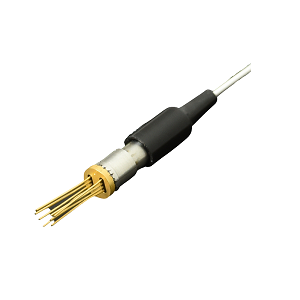
  • Z-Optics provides a full line of laser diodes from 405nm to 1625nm. All the products are qualified and operate reliably. Most products are on the shelf for quick delivery. Products listed in the table are not always updated on time. So just please tell us the wavelength, power, and package if not listed here, we will check our stock for you.
  • Z-Optics provides visible and infrared laser modules with circular, elliptic, linear, and cross-hair beam profiles in a variety of packages and configurations at very competitive prices. Our engineers have optics, crystal and laser background, years experiences in laser module design and production, which make us competitive in integrating the optics, electrics and laser together according to the requirements of customers. We promise one week delivery time for samples and 1-2 weeks for mass order.       Our Capability: Super Linearity and Flatness - A line laser module is developed, with only <2mm height difference over 1x1m2 flat surface, visible or infrared wavelength.Super Small Laser Module - A 650nm laser module is developed, with only 3.3mm diameter.Super directivity - the beam spot lies on the centre line of the laser module by fine design and adjustment.A 532nm laser module is under developing, which has the widest operation temperature window, -10~+50 Celsius degree. The most power-saving 532nm laser module is under developing *More dimensions, package, power level and high-quality products please download our catalogue

  • Z-Optics provides visible and infrared laser modules with circular, elliptic, linear, and cross-hair beam profiles in a variety of packages and configurations at very competitive prices. Our engineers have optics, crystal and laser background, years experience in laser module design and production, which make us competitive in integrating the optics, electrics and laser together according to the requirements of customers. We promise one week delivery time for samples and 1-2 weeks for mass order. Our Capability: Super Linearity and Flatness - A line laser module is developed, with only <2mm height difference over 1x1m2 flat surface, visible or infrared wavelength.Super Small Laser Module - A 650nm laser module is developed, with only 3.3mm diameter.Super directivity - the beam spot lies on the centre line of the laser module by fine design and adjustment.A 532nm laser module is under developing, which has the widest operation temperature window, -10~+50 Celsius degree. The most power-saving 532nm laser module is under developing *More dimensions, package, power level and high-quality products please download our catalogue

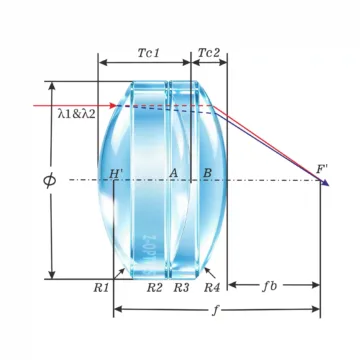
  • An achromatic lens is a type of lens that is designed to reduce chromatic aberration, which is the tendency of a lens to produce different colors of light in focus at different points. This is accomplished by combining two or more glass elements with different refractive indices. The most common type of achromatic lens is the doublet, which is made up of two elements, one concave and one convex. Achromatic lenses are commonly used in photography, telescope, microscope, and other imaging systems. They are also used in eyeglasses, binoculars and other optical instruments.
    Achromatic lenses are designed to correct for chromatic aberrations by combining two or more glass elements with different refractive indices. The most common type of achromatic lens is a doublet, which consists of one concave element and one convex element. The concave element is made of a low-dispersion glass, while the convex element is made of a higher-dispersion glass. When light passes through these two elements, the different dispersion properties of the glasses cause the different colors of light to come into focus at different distances. This is known as chromatic aberration. By carefully designing the curvatures of the elements and the spacing between them, the lens designer can create a lens that brings all colors of light into focus at the same distance, effectively eliminating chromatic aberration. Achromatic lenses are used in a wide range of applications where sharp and accurate imaging is critical, such as in photography, telescope, microscope, and other imaging systems. They are also used in eyeglasses, binoculars, and other optical instruments. Achromatic lenses are also commonly used in scientific research, for example in telescopes for studying stars, in microscopes for studying cells, in imaging systems for studying materials, and in other areas where precise imaging is necessary. In addition to the doublet lens there are also other types of achromatic lenses available, such as the achromatic triplet lens and the apochromatic lens. These lenses are designed to correct for chromatic aberrations even more effectively than the doublet lens, by using additional elements or specialized glasses. They are generally more expensive than doublet lenses but can offer even better image quality.
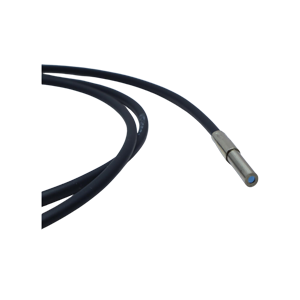
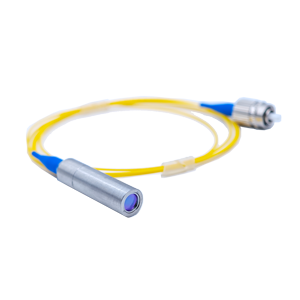
  • Normally there exits offset or angle between  Optical axis and mechanic axis of fiber collimator. That causes great insert loss. Collimators can’t be plug and play or rotated in use. The offset and angle between optical axis and mechanic axis of aligned fiber collimator are eliminated with ingenious design and precise assembling. It greatly improves installation efficiency with free adjustment. It also supports rotation of fiber collimator in use and can be used in optical fiber rotary connectors and other products.
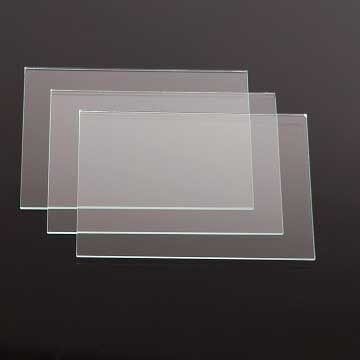
  • AG glass Windows is used on-screen to reduce sunlight/light reflection. The surface is etched by chemical to specified gloss, roughness and haze. A finished window might need post-treatment such as silk-screen printing, 3M double sides adhesive, heat tempered, coating. Please contact us for more information, supports or free samples.
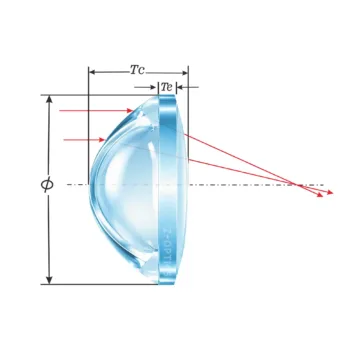
  • An Aspheric Lens is one whose surface profiles do not resemble those of a sphere or cylinder. In comparison to a basic lens, Aspherical Lens can reduce or eliminate spherical aberration and also other optical distortions such as astigmatism. Main Applications of Our Aspherical Lens: - Collimator or condenser of the light source. - Collimator of laser. - Coupling lens to focus laser into an optical fiber. - Imaging
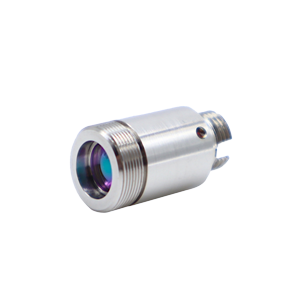
  • Aspheric Lens Fiberport Collimators  can correct spherical aberration. Energy of the laser has a Gaussian distribution and beam is well collimated. But it can‘t correct chromatic aberration. Because focal length of aspherical lens is related to wavelength.
  • Aspherical lens can correct spherical aberration. Energy of the laser has a Gaussian distribution and beam is well collimated. But it can‘t correct chromatic aberration, because the focal length is related to wavelength of laser.
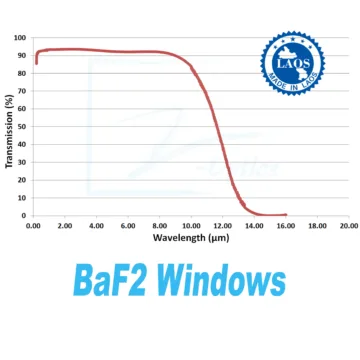
  • Barium Fluoride (BaF2) is the fastest known scintillator material; it has characteristics comparable to calcium fluoride but is more resistant to high-energy radiation. It is, however, more susceptible to water damage. Features
    • High-Energy Radiation Resistant
    • Transmission is excellent between 200nm - 12μm.
    • Provide high transmission without the use of AR coatings.
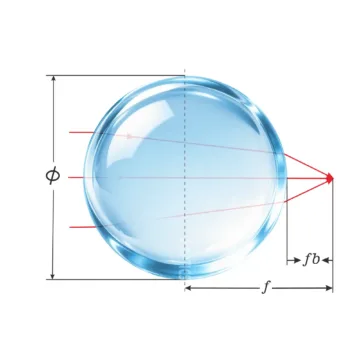
  • A special type of thick biconvex optical lens is a Ball lenses that usually has a sphere geometric shape. These are made of a single material such as BK7 or other optical glass/Fused Silica/CaF2 which is a commonly used material for ball lenses. The smallest lens we produced is < 0.5 mm. We can process ball lenses using all types of glass material. Our price for PV industry may be as low as USD0.02/pcs. We are developing CSD-based AR-coating to provide a low-cost PV-coating solution.
  • At Z-Optics, we engineer ultra-narrow bandpass filters designed for applications demanding the highest spectral precision-fluorescence spectroscopy, laser selection, Raman spectroscopy, and advanced sensor systems. Our FWHM 1–2 nm filters provide exceptional wavelength control, high transmission, and robust out-of-band rejection, ensuring your optical instruments deliver best-in-class performance.
    Key Features Ultra-Narrow Bandwidth: FWHM 1–2 nm for precise isolation of target wavelengths-minimize noise, maximize signal integrity. High Transmission: Up to 90% peak transmission at centre wavelengths-optimize light throughput for sensitive detection. Broad Blocking: OD4 blocking (1:10,000 attenuation) across wide out-of-band ranges (see individual product specifications)-eliminate stray light and improve signal-to-noise ratios. Precision Centre Wavelength: ±0.2–0.5 nm accuracy-ideal for systems requiring repeatable, calibration-grade performance. Wide Spectral Coverage: Comprehensive portfolio from UV to NIR (375–1064 nm)-match your application with the optimal filter.
  • At Z-Optics, our bandpass filters with a Full Width at Half Maximum (FWHM) of 10 to 15 nm are engineered for versatile optical systems requiring moderate spectral selectivity. These filters strike the perfect balance between spectral bandwidth and transmission efficiency, making them ideal for a wide range of scientific, industrial, and medical applications. With excellent out-of-band blocking and stable center wavelength control, they ensure consistent performance and reliable signal isolation.
    Key Features
    • Moderate Bandwidth: FWHM 10~15 nm ideal for applications where a balance of selectivity and throughput is required.
    • High Transmission: Achieves up to 85% peak transmission, maximizing usable signal intensity.
    • Strong Out-of-Band Rejection: Optical Density 3 to 4 blocking ensures minimized stray light for improved measurement accuracy.
    • Precision Centre Wavelength: Accurate within ±0.5 nm to ensure repeatable and reliable filter performance.
    • Durable Coatings: Advanced dielectric coatings provide long-term stability and environmental resistance.
    • Customizable Specifications: Available across UV, visible, and near-infrared spectral regions per customer requirements.
    Applications
    • Fluorescence microscopy and imaging
    • Laser line selection and spectral cleaning
    • Environmental and chemical sensing
    • Biomedical optics and diagnostic instrumentation
    • Raman spectroscopy with moderate spectral resolution needs
    • Optical communications and signal processing
  • At Z-Optics, we design precision bandpass filters with a Full Width Half Maximum (FWHM) of 2~3 nm, engineered for applications requiring outstanding spectral selectivity such as LiDAR systems, fluorescence spectroscopy, astronomical observation, and advanced sensor technologies. Our bandpass filters deliver ultra-narrow bandwidths that effectively minimize noise and spectral overlap, enhancing signal clarity even in challenging environments like light-polluted astronomical settings or complex laser setups.
    Key Features
    • Narrow Bandwidth: Precisely controlled FWHM of 2–3 nm allows for accurate isolation of target wavelengths, reducing interference and maximizing detection sensitivity.
    • High Transmission: Achieving transmission rates typically above 85–90% at center wavelengths, ensuring optimal light throughput for high-efficiency optical systems.
    • Robust Out-of-Band Blocking: High optical density blocking (e.g., OD4 or better) outside the passband to eliminate stray light and improve signal-to-noise ratio.
    • Stable Center Wavelength: Tight tolerance on center wavelength (±0.3–0.5 nm), providing repeatable and calibration-grade performance suitable for demanding scientific and industrial uses.
    • Wide Spectral Range: Available across UV to NIR wavelengths to match your specific application needs.
    Our 2~3 nm FWHM bandpass filters are especially valuable in:
    • Astronomical Observation: Efficiently suppress light pollution and spectral overlap to enable clear imaging of celestial objects such as nebulae.
    • LiDAR Systems: Deliver precise wavelength matching and wide-angle stability to ensure accurate long-range ranging and detection.
    • Laser Line Selection: Isolate narrow laser emission lines with minimal spectral distortion, critical for Raman spectroscopy and fluorescence excitation.
    • Advanced Medical and Scientific Instruments: Enhance signal integrity and minimize background noise in fluorescence sensors and spectroscopy devices.
    • By integrating our ultra-narrow 2–3 nm bandpass filters into your optical systems, you benefit from high transmission efficiency, excellent out-of-band rejection, and precise spectral control, boosting the performance and reliability of your instruments.
    This carefully optimized combination of bandwidth, transmission, and blocking characteristics makes our 2–3 nm FWHM bandpass filters ideal for high-performance optical instrumentation requiring ultra-narrow spectral filtering
  • At Z-Optics, our bandpass filters with FWHM 20–35 nm deliver reliable spectral filtering solutions for applications requiring moderate bandwidth and superior optical performance. Designed for enhanced light transmission and effective out-of-band blocking, these filters are ideal for fluorescence imaging, biomedical diagnostics, laser line isolation, and multispectral sensing technologies.
    Key Features
    • Optimized Bandwidth: FWHM ranging from 20 to 35 nm for balanced spectral selectivity, enabling clear isolation of target wavelengths while maintaining sufficient light throughput.
    • High Transmission Efficiency: Delivers up to 85% peak transmission at center wavelengths for improved signal strength and sensitivity in your optical system.
    • Robust Out-of-Band Blocking: OD3 or better blocking outside passband to suppress unwanted spectral components and reduce background noise.
    • Durable Coatings: Advanced dielectric coatings ensure stability and durability for demanding operational environments.
    • Versatile Spectral Range: Available in UV, visible, and NIR bands to suit diverse application needs from life sciences to industrial instrumentation.
    • Precision Wavelength Control: Center wavelength tolerance within ±1 nm for consistent, repeatable filtering performance.
    • Compact Form Factor: Compatible with standard optical setups and can be custom-sized upon request.
    Common Applications
    • Fluorescence microscopy and imaging
    • Laser line selection and suppression
    • Biomedical and diagnostic instrumentation
    • Environmental and chemical sensing
    • Multispectral and hyperspectral imaging systems
    • Optical communication and photonics research
  • At Z-Optics, our bandpass filters with FWHM 40~50 nm deliver reliable wavelength selection tailored for applications requiring moderate spectral resolution. These filters offer broad bandwidth suitable for fluorescence imaging, LED-based illumination systems, optical communication, and general light filtering applications — ensuring high transmission and efficient out-of-band rejection for enhanced optical system performance.
    Key Features
    • Moderate Bandwidth: FWHM 40~50 nm offering broad spectral filtering, ideal for less stringent wavelength isolation without compromising signal clarity.
    • High Transmission Efficiency: Typically exceeding 85% peak transmission, maximizing light throughput to boost system sensitivity and efficiency.
    • Excellent Out-of-Band Blocking: OD3 or better attenuation minimizes background noise caused by stray light and unwanted wavelengths.
    • Robust and Stable Design: Suitable for demanding environments with durable coatings ensuring long-term spectral stability and mechanical reliability.
    • Versatile Spectral Range: Available across visible and near-infrared ranges to support diverse applications from bioimaging to industrial optical setups.
    • Customizable Options: Center wavelengths and filter sizes can be tailored to meet specific system requirements.
    Applications
    • Fluorescence Imaging and Detection
    • LED Illumination and Lighting Control
    • Optical Communication Channels
    • Environmental and Chemical Sensing
    • Machine Vision and Inspection Systems
    • Photometric and Colorimetry Equipment
  • At Z-Optics, we design premium bandpass filters with FWHM 5~6 nm tailored for applications requiring a balance of spectral selectivity and high throughput, including advanced imaging, fluorescence, and laser systems. Our filters deliver excellent wavelength isolation, high peak transmission, and robust out-of-band blocking to enhance signal fidelity and system sensitivity.
    Key Features
    • Precise Spectral Bandwidth: FWHM 5~6 nm, enabling well-defined wavelength selection that reduces spectral noise without sacrificing throughput.
    • High Transmission Efficiency: Achieve up to 90% peak transmission at center wavelengths, maximizing light delivery for sensitive detection applications.
    • Strong Out-of-Band Blocking: Optical Density (OD) 4 or better blocking outside the passband, minimizing stray and background light for superior signal-to-noise ratios.
    • Accurate Center Wavelength Control: Center wavelength tolerance of ±0.5 nm assures consistent performance and reliable system calibration.
    • Durable Hard-Coated Optical Construction: Multi-layer dielectric coatings on UV fused silica substrates ensure long-lasting filter stability and resistance to environmental factors.
    Customizable Options: Available center wavelengths span UV to NIR regions with mounted sizes for easy integration into optical setups.

    The Bandpass Filter – FWHM 5~6nm from Z-Optics is ideally suited for a variety of high-precision optical applications where selective wavelength transmission and minimal spectral interference are critical. Key applications include:

    • Fluorescence Spectroscopy: Enables precise isolation of emission lines, improving signal clarity and analytical accuracy in biological and chemical fluorescence measurements.

    • Laser Line Selection: Ensures only the laser’s target wavelength passes while blocking other spectral components, enhancing laser system stability and performance.

    • Raman Spectroscopy: Provides spectral filtering to isolate Raman scattering signals with reduced background, crucial for materials identification and chemical analysis.

    • Optical Sensing and Imaging: Enhances performance of sensors and imaging devices by delivering high transmission at the desired wavelength with minimal noise, improving detection sensitivity.

    • Environmental and Medical Diagnostics: Supports systems requiring accurate spectral filtering to detect trace gases, biomarkers, or other analytes with high specificity.

    • Scientific Research and Instrumentation: Fits into advanced optical setups requiring calibration-grade wavelength stability and repeatability for experimental consistency.

    These applications leverage the filter’s combination of narrow bandwidth, high transmission, and strong out-of-band rejection to improve the fidelity and sensitivity of optical measurements and systems.

  • At Z-Optics, we offer premium-quality bandpass filters with a Full Width at Half Maximum (FWHM) of 50 to 60 nm, engineered to provide excellent spectral selection in a wider bandwidth range. These filters deliver reliable wavelength isolation with high transmission and effective out-of-band blocking, making them ideal for applications where broader spectral control is essential.
    Key Features
    • Wide Bandwidth Control: FWHM of 50–60 nm provides effective isolation of target spectral regions while allowing a broader range of wavelengths to pass through for diverse applications.
    • High Transmission Efficiency: Achieves over 85% peak transmission ensuring optimal light throughput with minimal losses.
    • Strong Out-of-Band Blocking: OD3 to OD4 blocking outside the passband reduces unwanted stray light for enhanced signal clarity.
    • Durable Optical Coatings: Designed for high durability and environmental stability, suitable for both laboratory and field use.
    • Customizable Centre Wavelength: Available across UV, visible, and near-infrared regions, with ±1 nm wavelength tolerance tailored to your system requirements.
    • Compact and Robust Design: Precision mounted filters compatible with standard optical holders and instruments.
    Applications
    • Fluorescence Imaging and Spectroscopy: Enables selection of excitation or emission bands with broader spectral tolerance.
    • Multispectral and Hyperspectral Imaging: Provides controlled spectral bands for imaging applications requiring medium bandwidth filters.
    • Environmental and Biological Sensing: Enhances detection of analytes across wider spectral signatures.
    • Laser Systems & Optical Communications: Ideal for wavelength selection and noise reduction in systems requiring mid-range FWHM filtering.
    • Industrial Process Monitoring: Facilitates spectral isolation of emissions or reflections in process control.
  • At Z-Optics, we offer high-performance bandpass filters with a Full Width at Half Maximum (FWHM) greater than 60 nm, expertly engineered to provide broad spectral selection for applications where wider bandwidths are essential. These filters deliver reliable wavelength isolation with high transmission efficiency, making them ideal for everyday industrial, scientific, and imaging applications that require consistent performance in demanding environments.
    Key Features
    • Wide Bandwidth: FWHM > 60 nm enables effective transmission of broader spectral bands supporting applications where larger wavelength windows are advantageous.
    • High Transmission Efficiency: Designed for peak transmission rates exceeding 85%, ensuring maximum light throughput for enhanced signal strength and sensitivity.
    • Reliable Out-of-Band Blocking: OD3 to OD4 blocking minimizes unwanted wavelengths and stray light ensuring signal clarity.
    • Durable and Stable Coatings: Optical coatings engineered for long-term stability and performance over a wide environmental range, suitable for both lab and field use.
    • Versatile Spectral Range: Available across UV, VIS, and NIR regions to accommodate diverse application needs.
    • Customizable Options: Filters can be tailored to precise wavelength ranges and physical dimensions to fit specific system requirements.
    Applications
    • Multispectral and hyperspectral imaging systems
    • Optical instrumentation and sensor technology
    • Fluorescence and chemiluminescence analysis where wider bandwidths improve signal capture
    • Environmental monitoring instruments
    • Industrial machine vision where broad spectral bands facilitate object detection under varying illumination
    • Biomedical diagnostics requiring sensitive yet broad spectral filtering
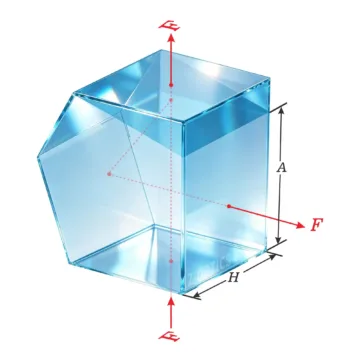
  • Beamsplitter Penta Prism is produced by bringing together a precision Penta Prism and a wedge prism and adding an appropriate interference coating to one of the typically reflective surfaces. Since minor motions of a Penta Prism do not influence the true right angle at which light rays are reflected, the difference between the light rays transmitted and reflected is highly controllable
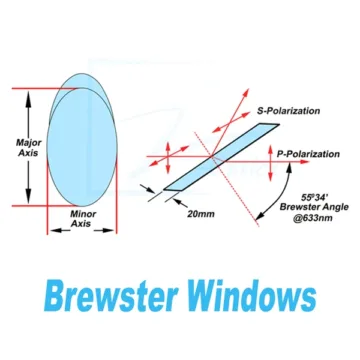
  • Brewster Windows are windows that are meant to be used at Brewster's angle (usually uncoated). This is the angle at which only incident p-polarized light has 0% transmission loss. Instead of exterior mirrors, a Brewster window is an uncoated substrate positioned at Brewster's angle within a laser. This substrate works as a polarizer, allowing p-polarized light to enter and exit the window without reflection losses while reflecting s-polarized light. Features
    • Perfect for Laser Cavities.
    • A substrate with UV Fused Silica.
    • Without Reflection Losses, P-Polarized Light is Transmitted.
     
  • Absorption loss to the interference coating is minimal by applying dielectric coating, but partially polarizing is induced. If polarization-sensitive is critical, please use our broadband non-polarizing cube Beamsplitter or polarizing cube Beamsplitter.
  • Broadband Dielectric Coated Flat Mirror, a optical component by Z-optics Company. This s mirror exemplifies Z-optics' unwavering commitment to precision engineering, innovation, and delivering superior optical solutions. This mirror is its high-quality dielectric coating. This dielectric coating not only ensures broad-spectrum reflectivity but also imparts exceptional durability, making the Broadband Dielectric Coated Flat Mirror a reliable choice for a myriad of optical applications. The mirror's flat substrate, constructed with meticulous attention to detail, serves as a stable base for the dielectric coating, guaranteeing consistent optical performance. Z-optics' stringent quality control measures are applied throughout the manufacturing process, ensuring that each mirror meets the company's exacting standards for precision and reliability.
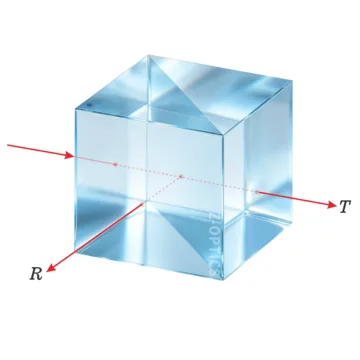
  • Broadband Non-Polarizing Cube Beamsplitters are made up of a pair of high precision right angle prisms cemented together by a metallic dielectric coating on one of the prisms’ hypotenuse. Because of the metallic dielectric hybrid coating's low polarization dependence, the transmission and reflection of S- and P-polarization states can be within 10% of each other. These beamsplitters are spectrally flat across their specified wavelength ranges, which reduces the effects of changes in angle of incidence or converging/diverging beams. Metallic dielectric hybrid coating has <10% absorption, so don’t use it in high power laser.

Go to Top