-
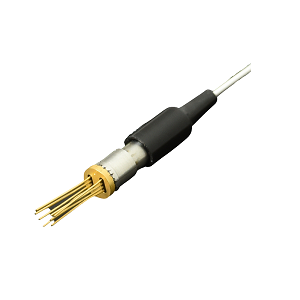
Z-Optics provides a full line of laser diodes from 405nm to 1625nm. All the products are qualified and operate reliably. Most products are on the shelf for quick delivery. Products listed in the table are not always updated on time. So just please tell us the wavelength, power, and package if not listed here, we will check our stock for you.
-
Z-Optics provides visible and infrared laser modules with circular, elliptic, linear, and cross-hair beam profiles in a variety of packages and configurations at very competitive prices. Our engineers have optics, crystal and laser background, years experiences in laser module design and production, which make us competitive in integrating the optics, electrics and laser together according to the requirements of customers. We promise one week delivery time for samples and 1-2 weeks for mass order.

 Our Capability: Super Linearity and Flatness - A line laser module is developed, with only <2mm height difference over 1x1m2 flat surface, visible or infrared wavelength.Super Small Laser Module - A 650nm laser module is developed, with only 3.3mm diameter.Super directivity - the beam spot lies on the centre line of the laser module by fine design and adjustment.A 532nm laser module is under developing, which has the widest operation temperature window, -10~+50 Celsius degree. The most power-saving 532nm laser module is under developing
*More dimensions, package, power level and high-quality products please download our catalogue
Our Capability: Super Linearity and Flatness - A line laser module is developed, with only <2mm height difference over 1x1m2 flat surface, visible or infrared wavelength.Super Small Laser Module - A 650nm laser module is developed, with only 3.3mm diameter.Super directivity - the beam spot lies on the centre line of the laser module by fine design and adjustment.A 532nm laser module is under developing, which has the widest operation temperature window, -10~+50 Celsius degree. The most power-saving 532nm laser module is under developing
*More dimensions, package, power level and high-quality products please download our catalogue
-
Z-Optics provides visible and infrared laser modules with circular, elliptic, linear, and cross-hair beam profiles in a variety of packages and configurations at very competitive prices. Our engineers have optics, crystal and laser background, years experience in laser module design and production, which make us competitive in integrating the optics, electrics and laser together according to the requirements of customers. We promise one week delivery time for samples and 1-2 weeks for mass order.
Our Capability: Super Linearity and Flatness - A line laser module is developed, with only <2mm height difference over 1x1m2 flat surface, visible or infrared wavelength.Super Small Laser Module - A 650nm laser module is developed, with only 3.3mm diameter.Super directivity - the beam spot lies on the centre line of the laser module by fine design and adjustment.A 532nm laser module is under developing, which has the widest operation temperature window, -10~+50 Celsius degree. The most power-saving 532nm laser module is under developing
*More dimensions, package, power level and high-quality products please download our catalogue
-
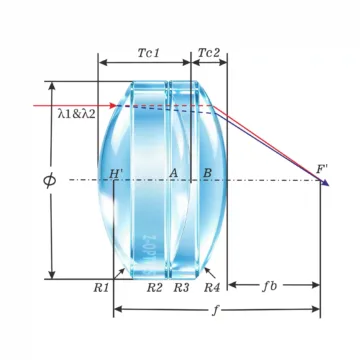
An achromatic lens is a type of lens that is designed to reduce chromatic aberration, which is the tendency of a lens to produce different colors of light in focus at different points. This is accomplished by combining two or more glass elements with different refractive indices. The most common type of achromatic lens is the doublet, which is made up of two elements, one concave and one convex. Achromatic lenses are commonly used in photography, telescope, microscope, and other imaging systems. They are also used in eyeglasses, binoculars and other optical instruments.
-
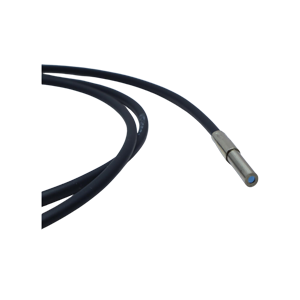
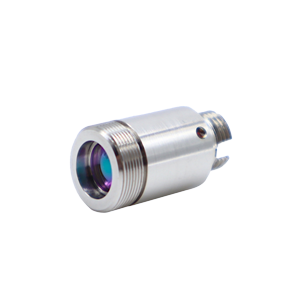
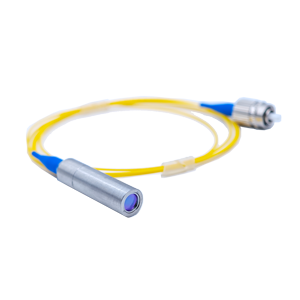
Normally there exits offset or angle between Optical axis and mechanic axis of fiber collimator. That causes great insert loss. Collimators can’t be plug and play or rotated in use. The offset and angle between optical axis and mechanic axis of aligned fiber collimator are eliminated with ingenious design and precise assembling. It greatly improves installation efficiency with free adjustment. It also supports rotation of fiber collimator in use and can be used in optical fiber rotary connectors and other products.
-
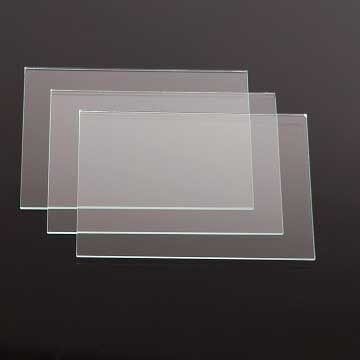
AG glass Windows is used on-screen to reduce sunlight/light reflection. The surface is etched by chemical to specified gloss, roughness and haze. A finished window might need post-treatment such as silk-screen printing, 3M double sides adhesive, heat tempered, coating. Please contact us for more information, supports or free samples.
-
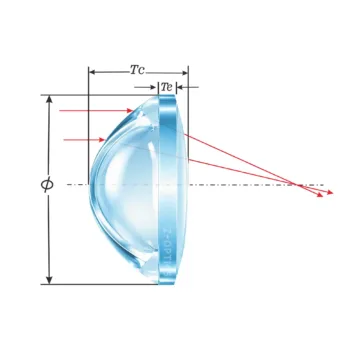
An Aspheric Lens is one whose surface profiles do not resemble those of a sphere or cylinder. In comparison to a basic lens, Aspherical Lens can reduce or eliminate spherical aberration and also other optical distortions such as astigmatism. Main Applications of Our Aspherical Lens: - Collimator or condenser of the light source. - Collimator of laser. - Coupling lens to focus laser into an optical fiber. - Imaging
-
Aspheric Lens Fiberport Collimators can correct spherical aberration. Energy of the laser has a Gaussian distribution and beam is well collimated. But it can‘t correct chromatic aberration. Because focal length of aspherical lens is related to wavelength.
-
-
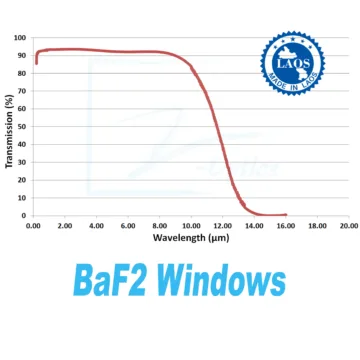
Barium Fluoride (BaF2) is the fastest known scintillator material; it has characteristics comparable to calcium fluoride but is more resistant to high-energy radiation. It is, however, more susceptible to water damage. Features
- High-Energy Radiation Resistant
- Transmission is excellent between 200nm - 12μm.
- Provide high transmission without the use of AR coatings.
-
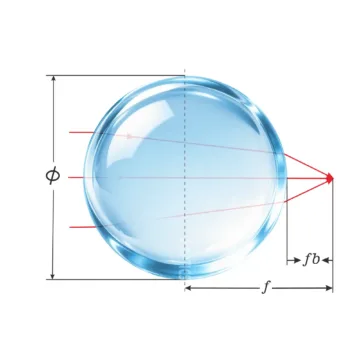
A special type of thick biconvex optical lens is a Ball lenses that usually has a sphere geometric shape. These are made of a single material such as BK7 or other optical glass/Fused Silica/CaF2 which is a commonly used material for ball lenses. The smallest lens we produced is < 0.5 mm. We can process ball lenses using all types of glass material. Our price for PV industry may be as low as USD0.02/pcs. We are developing CSD-based AR-coating to provide a low-cost PV-coating solution.
-
At Z-Optics, we engineer hard-coated BANDPASS FILTER - FWHM 1~2nm optics for high-precision Raman spectroscopy, fluorescence, and laser selection. Featuring center wavelengths from 375nm to 1064nm, these narrow bandpass filters deliver peak transmission up to 90%, deep out-of-band rejection (OD4 across 200-1200nm), and standard diameters of 12.7mm and 25.4mm. Designed to meet strict industrial standards, they maximize the signal-to-noise ratio in advanced instrumentation.
-
At Z-Optics, our bandpass filters with a Full Width at Half Maximum (FWHM) of 10 to 15 nm are engineered for versatile optical systems requiring moderate spectral selectivity. These filters strike the perfect balance between spectral bandwidth and transmission efficiency, making them ideal for a wide range of scientific, industrial, and medical applications. With excellent out-of-band blocking and stable center wavelength control, they ensure consistent performance and reliable signal isolation.
-
At Z-Optics, we design precision bandpass filters with a Full Width Half Maximum (FWHM) of 2~3 nm, engineered for applications requiring outstanding spectral selectivity such as LiDAR systems, fluorescence spectroscopy, astronomical observation, and advanced sensor technologies. Our bandpass filters deliver ultra-narrow bandwidths that effectively minimize noise and spectral overlap, enhancing signal clarity even in challenging environments like light-polluted astronomical settings or complex laser setups.
-
At Z-Optics, our bandpass filters with FWHM 20–35 nm deliver reliable spectral filtering solutions for applications requiring moderate bandwidth and superior optical performance. Designed for enhanced light transmission and effective out-of-band blocking, these filters are ideal for fluorescence imaging, biomedical diagnostics, laser line isolation, and multispectral sensing technologies.
-
At Z-Optics, our bandpass filters with FWHM 40~50 nm deliver reliable wavelength selection tailored for applications requiring moderate spectral resolution. These filters offer broad bandwidth suitable for fluorescence imaging, LED-based illumination systems, optical communication, and general light filtering applications — ensuring high transmission and efficient out-of-band rejection for enhanced optical system performance.
-
At Z-Optics, we design premium bandpass filters with FWHM 5~6 nm tailored for applications requiring a balance of spectral selectivity and high throughput, including advanced imaging, fluorescence, and laser systems. Our filters deliver excellent wavelength isolation, high peak transmission, and robust out-of-band blocking to enhance signal fidelity and system sensitivity.
-
At Z-Optics, we offer premium-quality bandpass filters with a Full Width at Half Maximum (FWHM) of 50 to 60 nm, engineered to provide excellent spectral selection in a wider bandwidth range. These filters deliver reliable wavelength isolation with high transmission and effective out-of-band blocking, making them ideal for applications where broader spectral control is essential.
-
At Z-Optics, we offer high-performance bandpass filters with a Full Width at Half Maximum (FWHM) greater than 60 nm, expertly engineered to provide broad spectral selection for applications where wider bandwidths are essential. These filters deliver reliable wavelength isolation with high transmission efficiency, making them ideal for everyday industrial, scientific, and imaging applications that require consistent performance in demanding environments.
-
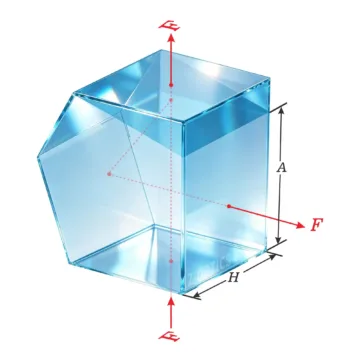
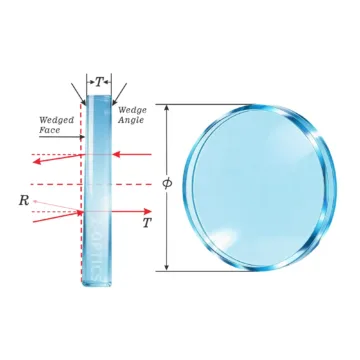
Beamsplitter Penta Prism is produced by bringing together a precision Penta Prism and a wedge prism and adding an appropriate interference coating to one of the typically reflective surfaces. Since minor motions of a Penta Prism do not influence the true right angle at which light rays are reflected, the difference between the light rays transmitted and reflected is highly controllable
-
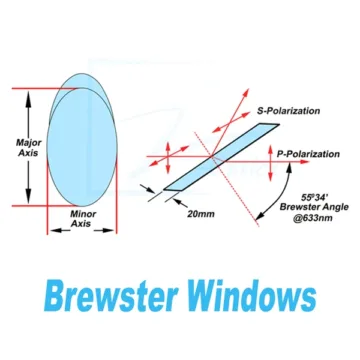
Brewster Windows are windows that are meant to be used at Brewster's angle (usually uncoated). This is the angle at which only incident p-polarized light has 0% transmission loss. Instead of exterior mirrors, a Brewster window is an uncoated substrate positioned at Brewster's angle within a laser. This substrate works as a polarizer, allowing p-polarized light to enter and exit the window without reflection losses while reflecting s-polarized light. Features
- Perfect for Laser Cavities.
- A substrate with UV Fused Silica.
- Without Reflection Losses, P-Polarized Light is Transmitted.
-
-
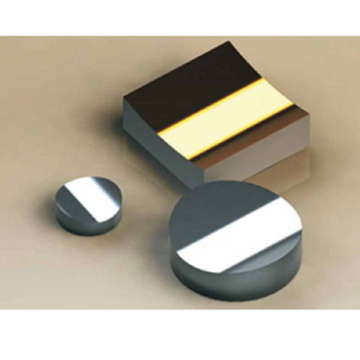
Broadband Dielectric Coated Flat Mirror, a optical component by Z-optics Company. This s mirror exemplifies Z-optics' unwavering commitment to precision engineering, innovation, and delivering superior optical solutions. This mirror is its high-quality dielectric coating. This dielectric coating not only ensures broad-spectrum reflectivity but also imparts exceptional durability, making the Broadband Dielectric Coated Flat Mirror a reliable choice for a myriad of optical applications. The mirror's flat substrate, constructed with meticulous attention to detail, serves as a stable base for the dielectric coating, guaranteeing consistent optical performance. Z-optics' stringent quality control measures are applied throughout the manufacturing process, ensuring that each mirror meets the company's exacting standards for precision and reliability.
-
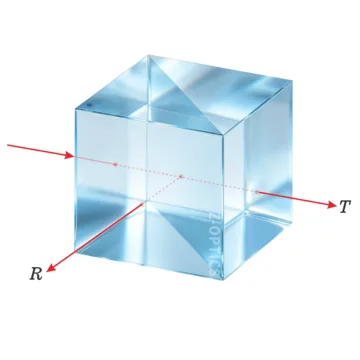
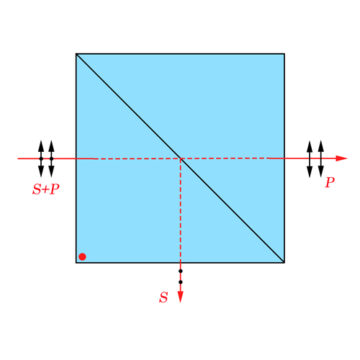
Broadband Non-Polarizing Cube Beamsplitters are made up of a pair of high precision right angle prisms cemented together by a metallic dielectric coating on one of the prisms’ hypotenuse. Because of the metallic dielectric hybrid coating's low polarization dependence, the transmission and reflection of S- and P-polarization states can be within 10% of each other. These beamsplitters are spectrally flat across their specified wavelength ranges, which reduces the effects of changes in angle of incidence or converging/diverging beams. Metallic dielectric hybrid coating has <10% absorption, so don’t use it in high power laser.
-
Beamsplitters are used for separating or merging light beams. The two common forms Z-OPTICS LIMITED offers are Plates and cubes. Cubes are a simple, safe shape for applications with low power rates. The efficiency of beamsplitters depends largely on the parameters for the coating. The type, coating, transmission range and damage threshold should be taken into consideration when choosing beamsplitters.
-
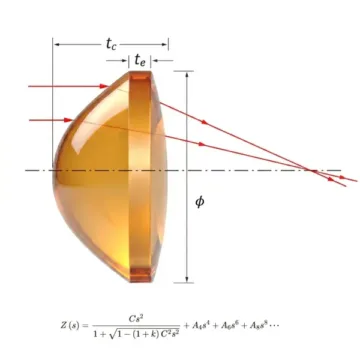
A Zinc Selenide (ZnSe) Aspheric Lens features a specialized surface profile designed to eliminate spherical aberration and minimize optical distortions like astigmatism, providing superior focus and clarity in infrared systems compared to standard spherical lenses. Main Applications of Our ZnSe Aspherical Lens:
- CO2 Laser Collimation: Functions as a high-efficiency collimator or condenser for high-power infrared light sources.
- Laser Beam Shaping: Serves as a precision collimator for high-power industrial and medical laser systems.
- Fiber Optic Coupling: Acts as a high-performance coupling lens to efficiently focus infrared laser beams into optical fibers.
- Infrared Thermal Imaging: Enhances resolution and image quality in thermal imaging cameras and FLIR systems operating in the MWIR and LWIR spectrums.
-
A Zinc Selenide (ZnSe) Aspheric Lens features a specialized surface profile designed to eliminate spherical aberration and minimize optical distortions like astigmatism, providing superior focus and clarity in infrared systems compared to standard spherical lenses. Main Applications of Our ZnSe Aspherical Lens:
- CO2 Laser Collimation: Functions as a high-efficiency collimator or condenser for high-power infrared light sources.
- Laser Beam Shaping: Serves as a precision collimator for high-power industrial and medical laser systems.
- Fiber Optic Coupling: Acts as a high-performance coupling lens to efficiently focus infrared laser beams into optical fibers.
- Infrared Thermal Imaging: Enhances resolution and image quality in thermal imaging cameras and FLIR systems operating in the MWIR and LWIR spectrums.
-
A Zinc Selenide (ZnSe) Aspheric Lens features a specialized surface profile designed to eliminate spherical aberration and minimize optical distortions like astigmatism, providing superior focus and clarity in infrared systems compared to standard spherical lenses. Main Applications of Our ZnSe Aspherical Lens:
- CO2 Laser Collimation: Functions as a high-efficiency collimator or condenser for high-power infrared light sources.
- Laser Beam Shaping: Serves as a precision collimator for high-power industrial and medical laser systems.
- Fiber Optic Coupling: Acts as a high-performance coupling lens to efficiently focus infrared laser beams into optical fibers.
- Infrared Thermal Imaging: Enhances resolution and image quality in thermal imaging cameras and FLIR systems operating in the MWIR and LWIR spectrums.
-
A Zinc Selenide (ZnSe) Aspheric Lens features a specialized surface profile designed to eliminate spherical aberration and minimize optical distortions like astigmatism, providing superior focus and clarity in infrared systems compared to standard spherical lenses. Main Applications of Our ZnSe Aspherical Lens:
- CO2 Laser Collimation: Functions as a high-efficiency collimator or condenser for high-power infrared light sources.
- Laser Beam Shaping: Serves as a precision collimator for high-power industrial and medical laser systems.
- Fiber Optic Coupling: Acts as a high-performance coupling lens to efficiently focus infrared laser beams into optical fibers.
- Infrared Thermal Imaging: Enhances resolution and image quality in thermal imaging cameras and FLIR systems operating in the MWIR and LWIR spectrums.
-
A Zinc Selenide (ZnSe) Aspheric Lens features a specialized surface profile designed to eliminate spherical aberration and minimize optical distortions like astigmatism, providing superior focus and clarity in infrared systems compared to standard spherical lenses. Main Applications of Our ZnSe Aspherical Lens:
- CO2 Laser Collimation: Functions as a high-efficiency collimator or condenser for high-power infrared light sources.
- Laser Beam Shaping: Serves as a precision collimator for high-power industrial and medical laser systems.
- Fiber Optic Coupling: Acts as a high-performance coupling lens to efficiently focus infrared laser beams into optical fibers.
- Infrared Thermal Imaging: Enhances resolution and image quality in thermal imaging cameras and FLIR systems operating in the MWIR and LWIR spectrums.
-
The Caf2 (Calcium Fluoride) Wedge Beamsplitter is a cutting-edge optical component that has garnered significant attention across various scientific, industrial, and laser-based applications. This is meticulously designed to bifurcate incoming light into two separate beams, each with a predetermined ratio of reflected and transmitted light, making it an indispensable tool for precision light management within optical systems.
-
Calcium Fluoride (CaF2) Windows have a high damage threshold and low absorption and are transparent from 180 nm to 8µm. It is a great choice for FTIR analysis, excimer laser systems, spectroscopic windows, and thermal imaging systems. Features:
- <1 arc-minute parallelism
- Ideally suited for excimer laser applications.
- Transparent in UV, visible, and infrared light.
- A low absorption rate and a high damage threshold
- In comparison to other IR materials, it has a low chromatic aberration.
-
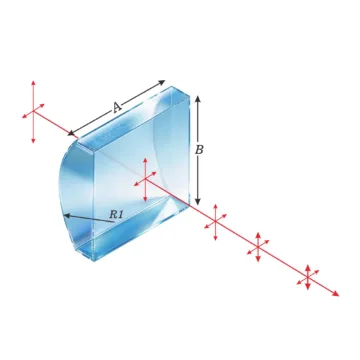
Concave Sphere Mirror and Concave Cylindrical Mirror, are optical components that showcase precision engineering. These mirrors exemplify Z-optics' commitment to delivering superior optical solutions. The Concave Sphere Mirror boasts a precisely curved surface designed to converge incident light, making it ideal for applications requiring focused reflection, such as in telescopes or imaging systems. Z-optics' advanced manufacturing processes ensure the curvature meets exact specifications, providing consistent and reliable optical performance.
-
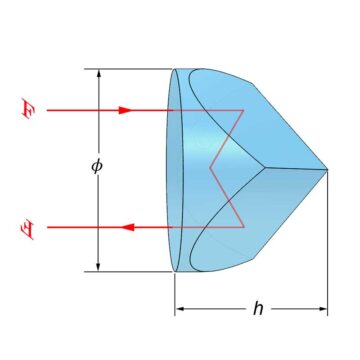
Z-optics is a leading manufacturer of Corner Cube Retroreflectors for a wide range of applications. We are proud to be a biggest manufacturer of Corner Cube Retroreflectors worldwide, producing nearly half a million pieces each year. Our dedication to providing high-quality retroreflectors ensures that our customers receive the precision and reliability they need for their specific applications.

-
- Z-OPTICS has big catalog of cylindrical lens off-the-shelf for quick delivery and provides quick sampling service for new drawings.
- Multiplicity of materials, Glass, Fused Silica, Sapphire, CaF2, ZnSe ….
- Innovative low cost plano convex cylindrical lens is available.
Overview
- Ready Stock: Z-Optics offers a large catalog of cylindrical lenses available for fast delivery and custom sampling for your unique designs.
- Material Multiplicity: Select from premium optical glass, fused silica, sapphire, CaF2, ZnSe, and more—a solution for every requirement.
- Cost-Effective Options: Innovative low-cost plano convex cylindrical lenses and specialized shapes for demanding optical applications.
-
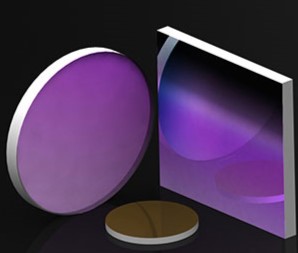
Dichroic Filter from Z-Optics is a precision optical component designed to selectively transmit and reflect specific wavelengths of light, enhancing color separation and spectral control in various high-performance optical systems. These filters operate using thin-film interference technology and are typically set at a 45° angle of incidence, reflecting undesired wavelengths while transmitting the targeted light spectrum with high efficiency and durability....