Call Us Today! +856 20 5658 8665|sales@z-optics.com
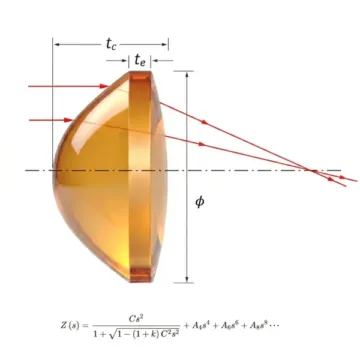
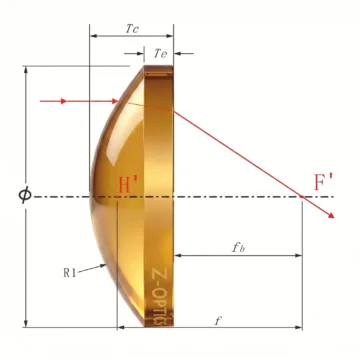
  • A Zinc Selenide (ZnSe) Aspheric Lens features a specialized surface profile designed to eliminate spherical aberration and minimize optical distortions like astigmatism, providing superior focus and clarity in infrared systems compared to standard spherical lenses. Main Applications of Our ZnSe Aspherical Lens:
    • CO2 Laser Collimation: Functions as a high-efficiency collimator or condenser for high-power infrared light sources.
    • Laser Beam Shaping: Serves as a precision collimator for high-power industrial and medical laser systems.
    • Fiber Optic Coupling: Acts as a high-performance coupling lens to efficiently focus infrared laser beams into optical fibers.
    • Infrared Thermal Imaging: Enhances resolution and image quality in thermal imaging cameras and FLIR systems operating in the MWIR and LWIR spectrums.
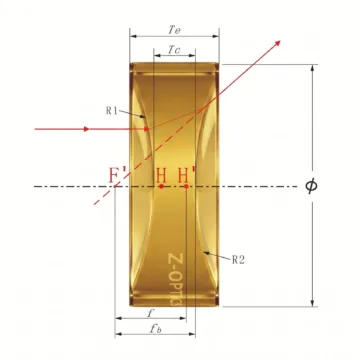
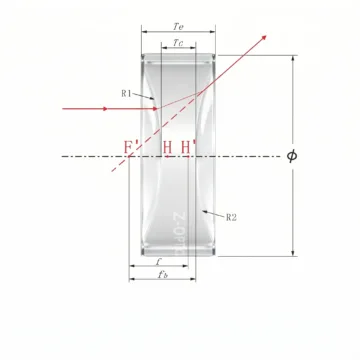
  • A Zinc Selenide (ZnSe) Double Concave Lens features two symmetrical inner-curved surfaces designed to diverge incident infrared light, increase focal lengths, and expand laser beams with exceptional wavefront clarity. Engineered from premium CVD laser-grade Zinc Selenide and optimized for a 10.6 µm design wavelength, these negative lenses come standard with our high-efficiency IR2 broadband anti-reflection (BBAR) coating, yielding an average reflectance (R_avg) of less than 1.5% across the 8–12 µm long-wave infrared (LWIR) spectrum.
    Main Applications of Our ZnSe Double Concave Lens:
    • CO2 Laser Beam Expansion: Functions as a highly durable negative component within Galilean beam expanders to safely diverge and enlarge high-power 10.6 µm laser beams before collimation.
    • Optical System Focal Extension: Serves as a precision diverging lens to counteract positive aberrations, minimize spherical distortion, and extend the effective focal length of multi-element IR imaging assemblies.
    • Infrared Imaging & Sensing: Acts as an efficient dispersing lens to widen the field of view for LWIR thermal imaging cameras, FLIR systems, and horizon-scanning optical sensors.
    • Industrial and Medical Laser Shaping: Optimizes beam profiles and energy distribution for precise material processing, micro-machining, and surgical laser systems.
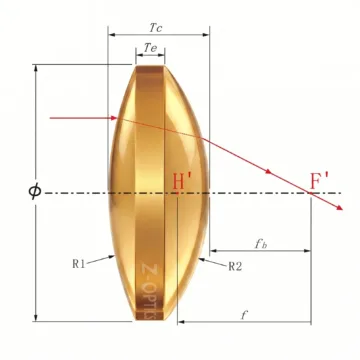
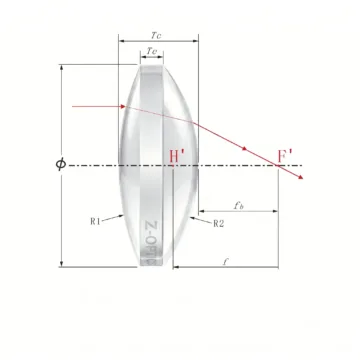
  • A Zinc Selenide (ZnSe) Double Convex Lens features two symmetrical, outward-curved surfaces engineered to converge incident infrared light, reduce focal lengths, and focus high-power laser beams with exceptional wavefront clarity. Fabricated from premium CVD laser-grade material and optimized for a 10.6 µm design wavelength, these bi-convex positive lenses deliver low bulk absorption and high transmission across the infrared spectrum.
    Applications of Our ZnSe Double Convex Lens:
    • CO2 Laser Focusing & Collimation: Functions as a highly efficient focusing element or beam collimator for high-power CO2 laser cutting, engraving, and welding systems.
    • Laser Beam Shaping: Serves as a precision focusing lens to concentrate infrared light into high-intensity spots for industrial and medical laser procedures.
    • Fiber Optic Coupling: Acts as a high-performance coupling lens to efficiently condense and couple infrared laser outputs directly into optical fibers.
    • Infrared Thermal Imaging: Works as a high-efficiency condenser lens to maximize light gathering and improve resolution in thermal imaging cameras and FLIR sensing systems operating in the MWIR and LWIR bands.
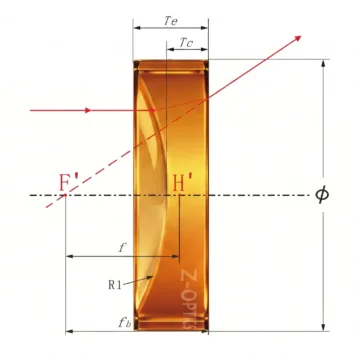
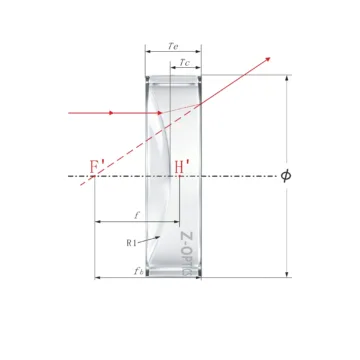
  • A Zinc Selenide (ZnSe) Plano-Concave Lens features one flat and one inward-curved surface engineered to diverge incident infrared light, extend focal lengths, and expand high-power laser beams with exceptional wavefront clarity. Fabricated from premium CVD laser-grade substrate material and optimized for a 10.6 µm design wavelength, these negative lenses deliver low bulk absorption and high transmission across the infrared spectrum. Available in both uncoated configurations and high-efficiency IR2 anti-reflection coatings (Ravg < 1.5% @ 8–12 µm), our lenses are precision-manufactured with a strict surface quality of 60-40 and an EFL tolerance of ±1%.
    Applications of Our ZnSe Plano-Concave Lens:
    • CO2 Laser Beam Expansion: Functions as a highly efficient diverging element in Galilean beam expander configurations for high-power 10.6 µm CO2 laser cutting, engraving, and marking systems.
    • Laser Beam Shaping & Aberration Correction: Serves as a precision diverging lens to balance spherical aberrations and optimize laser beam profiles in advanced industrial and medical optical paths.
    • Optical System Integration: Acts as a high-performance negative lens to extend focal lengths, control collimated beam diameters, and minimize power density on downstream optical components.
    • Infrared Thermal Imaging & FLIR: Works as a critical optical component to manipulate fields of view and balance optical paths in thermal imaging cameras and FLIR sensing systems operating across the 8–12 µm LWIR bands.
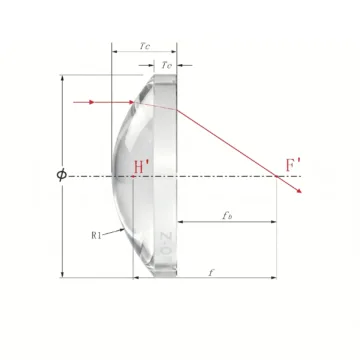
  • ZnSe (Zinc Selenide) plano-convex lenses are essential optical elements manufactured from high-purity chemical vapor deposition (CVD) laser-grade material. Designed with one flat surface and one spherical convex surface, these lenses exhibit exceptionally low bulk absorption and high transmission in the infrared spectrum, making them the industry standard for focusing collimated beams or collimating point sources in high-power infrared systems. Technical Applications & Industrial Use Cases
    Due to their outstanding thermal properties, minimal phase distortion, and robust optical transmission in the 8 to 12 micrometer wavelength range, ZnSe plano-convex lenses are widely deployed across demanding sectors:
    • High-Power CO2 Laser Systems: Act as primary focusing lenses in industrial CO2 laser cutting, welding, and marking machines operating at 10.6 micrometers.
    • Thermal Imaging & Sensing: Utilized in thermal cameras, infrared detectors, and optical pyrometers requiring precise focal stability across the mid-to-far infrared bands.
    • Medical & Scientific Instrumentation: Deployed in infrared spectroscopy and medical laser delivery assemblies where beam waist minimization and thermal lens mitigation are critical.

    Key Specifications & Performance Advantages

    • Material: CVD Laser-Grade Zinc Selenide (ZnSe) optimized for high-power infrared applications.
    • Design Wavelength: Engineered specifically for 10.6 micrometer laser systems with strict focal length tolerance.
    • Surface Quality: High-precision 60-40 scratch-dig with tight centration tolerance (< 3 arcmin) and protective chamfers.
    • Coating Options: Available uncoated or featuring specialized low-absorption infrared anti-reflective (IR2) coatings (average reflectance < 1.5% across 8 to 12 micrometers) to maximize throughput.
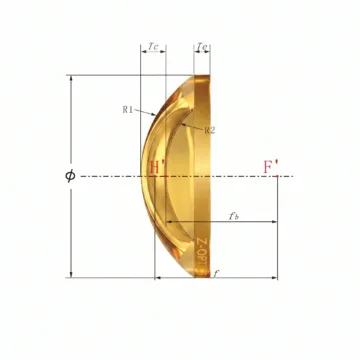
  • ZnSe (Zinc Selenide) positive meniscus lenses are high-performance optical elements manufactured from high-purity chemical vapor deposition (CVD) laser-grade material. Designed with a convex front surface and a concave rear surface, these lenses effectively minimize spherical aberration when used in high-power laser systems, producing a smaller focal spot size and superior beam-focusing precision.
    Technical Applications & Industrial Use Cases Due to their exceptional thermal stability, low absorption coefficient, and ability to shorten focal lengths while maintaining high image quality, ZnSe positive meniscus lenses are widely deployed across demanding sectors:
    • High-Power CO2 Laser Systems: Act as primary focusing lenses in industrial CO2 laser cutting, welding, and engraving machines operating at 10.6 micrometers.
    • Thermal Imaging & Sensing: Utilized in thermal cameras, infrared detectors, and optical pyrometers requiring precise focal stability across mid-to-far infrared bands.
    • Medical & Scientific Instrumentation: Deployed in infrared spectroscopy and medical laser delivery assemblies where beam waist minimization and thermal lens mitigation are critical.
    Key Specifications & Performance Advantages
    • Material: CVD Laser-Grade Zinc Selenide (ZnSe) optimized for high-power infrared applications.
    • Design Wavelength: Engineered specifically for 10.6 micrometer laser systems with strict focal length tolerance
    • Surface Quality: High-precision 60-40 scratch-dig with tight centration tolerance (< 3 arcmin) and protective chamfers.
    • Coating Options: Available uncoated or featuring specialized low-absorption infrared anti-reflective (IR2) coatings (average reflectance < 1.5% across 8 to 12 micrometers) to maximize throughput.
  • CaF2 (Calcium Fluoride) Double Concave Lenses are high-precision optical components manufactured from high-purity calcium fluoride single crystals. Featuring two concave surfaces, these negative focal length lenses are designed for beam expansion, image projection, and optical system miniaturization, offering exceptionally high transmission from the ultraviolet (UV) through the visible and into the infrared (IR) spectrum with minimal chromatic aberration.
    Technical Applications & Industrial Use Cases Due to their wide transmission range, low refractive index, and high laser damage threshold, CaF2 double concave lenses are widely deployed across demanding high-tech sectors:
    • Laser Beam Expansion: Act as divergence elements in laser beam expanders and spatial filtering setups across UV, visible, and IR wavelengths.
    • Thermal Imaging & Spectroscopy: Utilized in multi-spectral optical assemblies, FTIR spectrometers, and thermal imaging systems operating in the 3 to 5 micrometer infrared band.
    • UV & Excimer Laser Systems: Deployed in semiconductor lithography, laser material processing, and scientific research requiring high resistance to laser-induced damage.
    Key Specifications & Performance Advantages
    • Material: High-purity Calcium Fluoride (CaF2) single crystal optimized for broad-band transmission.
    • Design Wavelength: Engineered for precision performance with strict focal length tolerance (EFL $\pm 1\%$).
    • Surface Quality: High-precision 60-40 scratch-dig with tight centration tolerance (< 3 arcmin) and protective chamfers ($0.2\text{ mm} \times 45^{\circ}$).
    • Coating Options: Available uncoated or featuring specialized low-absorption infrared anti-reflective (IR1) coatings (average reflectance < 1.5% across 3 to 5 micrometers) to maximize throughput.
  • CaF2 (Calcium Fluoride) plano-concave lenses are high-performance negative optical elements manufactured from high-purity calcium fluoride single crystals. Featuring one flat surface and one concave surface, these lenses provide a negative focal length used for beam divergence, projection systems, and optical path expansion, boasting exceptionally wide transmission from the ultraviolet (UV) through the visible and into the infrared (IR) spectrum with minimal wavefront distortion.
    Technical Applications & Industrial Use Cases Due to their broad transmission window, extremely low refractive index change with temperature, and high resistance to laser-induced damage, CaF2 plano-concave lenses are vital across precision industries:
    • Laser Beam Expansion & Divergence: Utilized as divergence elements in beam expanders and spatial filtering assemblies across UV, visible, and infrared laser systems[cite: 10].
    • Thermal Imaging & Multi-Spectral Optics: Deployed in thermal cameras, FLIR systems, and infrared detectors operating in the 3 to 5 micrometer spectral band[cite: 10].
    • Scientific & UV Instrumentation: Perfect for excimer laser optics, spectrophotometers, and astronomical observation equipment requiring broad broadband transparency.
    Key Specifications & Performance Advantages
    • Material: High-purity Calcium Fluoride (CaF2) single crystal optimized for wide-band transmission.
    • Design Wavelength: Calibrated for precision performance with strict focal length tolerance.
    • Surface Quality: High-precision 60-40 scratch-dig with tight centration tolerance (< 3 arcmin) and protective chamfers.
    • Coating Options: Available uncoated or featuring specialized low-absorption infrared anti-reflective (IR1) coatings (average reflectance < 1.5% across 3 to 5 micrometers) to maximize throughput.
  • CaF2 (Calcium Fluoride) plano-convex cylindrical lenses are specialized optical components manufactured from high-purity calcium fluoride single crystals. Featuring one flat surface and one cylindrical convex surface, these lenses focus or expand light in a single dimension only, offering exceptionally wide broadband transmission from the ultraviolet (UV) through the visible and into the infrared (IR) spectrum with minimal wavefront aberration.
    Technical Applications & Industrial Use Cases Due to their wide transmission window, low refractive index dispersion, and high resistance to laser-induced damage, CaF2 plano-convex cylindrical lenses are essential across precision optical systems:
    • Laser Line Generation: Used to shape point laser sources into uniform line beams for machine vision, laser scanning, and material processing.
    • Anamorphic Beam Shaping: Deployed in optical systems to correct astigmatism or adjust the aspect ratio of diode laser outputs.
    • Thermal Imaging & Spectroscopy: Utilized in multi-spectral optical assemblies, FTIR spectrometers, and infrared detectors operating in the 3 to 5 micrometer infrared band.
    Key Specifications & Performance Advantages
    • Material: High-purity Calcium Fluoride (CaF2) single crystal optimized for broad-band transmission.
    • Design Wavelength: Calibrated for precision performance at 587.6 nm with strict focal length tolerance.
    • Surface Quality: High-precision 60-40 scratch-dig with tight centration tolerance (< 3 arcmin) and protective chamfers.
    • Coating Options: Available uncoated or featuring specialized low-absorption infrared anti-reflective (IR1) coatings (average reflectance < 1.5% across 3 to 5 micrometers) to maximize throughput.
  • CaF2 (Calcium Fluoride) plano-convex lenses are high-performance positive optical elements manufactured from high-purity calcium fluoride single crystals. Featuring one flat surface and one spherical convex surface, these lenses provide positive focal lengths for focusing collimated beams or collimating point sources, delivering exceptionally broad broadband transmission from the ultraviolet (UV) through the visible and into the infrared (IR) spectrum with minimal wavefront distortion.
    Technical Applications & Industrial Use Cases Due to their wide transmission window, extremely low refractive index dispersion, and high resistance to laser-induced damage, CaF2 plano-convex lenses are vital across precision industries:
    • Laser Focusing & Collimation: Utilized as primary focusing and collimating elements in UV, visible, and infrared laser systems requiring high threshold damage resistance.
    • Thermal Imaging & Multi-Spectral Optics: Deployed in thermal cameras, FLIR systems, and infrared detectors operating in the 3 to 5 micrometer spectral band.
    • Scientific & UV Instrumentation: Perfect for excimer laser optics, spectrophotometers, and astronomical observation equipment demanding wide transparency.
    Key Specifications & Performance Advantages
    • Material: High-purity Calcium Fluoride (CaF2) single crystal optimized for wide-band transmission.
    • Design Wavelength: Calibrated for precision performance at 587.6 nm with strict focal length tolerance .
    • Surface Quality: High-precision 60-40 scratch-dig with tight centration tolerance (< 3 arcmin) and protective chamfers .
    • Coating Options: Available uncoated or featuring specialized low-absorption infrared anti-reflective (IR1) coatings (average reflectance < 1.5% across 3 to 5 micrometers) to maximize throughput.
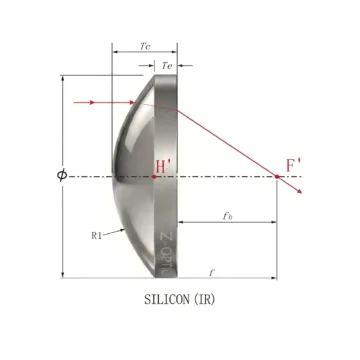
  • Silicon (Si) plano-concave lenses are high-performance negative optical elements manufactured from optical-grade monocrystalline silicon. Featuring one flat surface and one spherical concave surface, these lenses provide a negative focal length ideal for beam expansion, divergence control, and optical system miniaturization in the infrared spectrum, boasting high refractive index and excellent thermal conductivity.

    Technical Applications & Industrial Use Cases Due to their high refractive index, robust mechanical durability, and exceptional transmission in the near-to-mid infrared bands, silicon plano-concave lenses are widely deployed across high-tech industries:
    • Infrared Laser Systems: Act as divergence and beam expansion optics in high-powered infrared laser setups operating around 3 to 5 micrometers.
    • Thermal Imaging & FLIR: Utilized in thermal cameras, night vision equipment, and infrared sensing assemblies requiring rugged optical windows and lenses.
    • Spectroscopy & Defense Optics: Deployed in multi-spectral optical instruments, pyrometers, and aerospace guidance systems.
    Key Specifications & Performance Advantages
    • Material: Optical-Grade Monocrystalline Silicon (Si) optimized for infrared applications.
    • Design Wavelength: Calibrated for precision performance at 4 micrometers with strict focal length tolerance.
    • Surface Quality: High-precision 60-40 scratch-dig with tight centration tolerance (< 3 arcmin) and protective chamfers.
    • Coating Options: Available uncoated or featuring specialized low-absorption infrared anti-reflective (IR1) coatings (average reflectance < 1.5% across 3 to 5 micrometers) to maximize throughput.
Go to Top