-
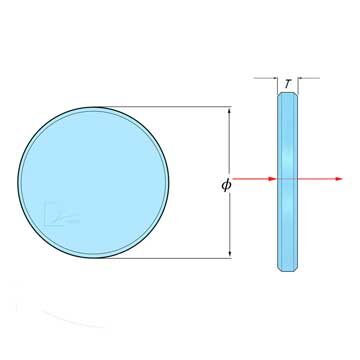
Discover Z-Optics Notch Filters, precision-engineered optical components designed to selectively block specific wavelengths with high accuracy while maintaining excellent transmission outside the blocked band. Our notch filters are ideal for advanced optical systems requiring precise wavelength control, such as laser protection, fluorescence microscopy, Raman spectroscopy, and telecommunications.
-
Out of stockZ-Optics provides visible and infrared laser modules with circular, elliptic, linear, and cross-hair beam profiles in a variety of packages and configurations at very competitive prices. Our engineers have optics, crystal and laser background, years experiences in laser module design and production, which make us competitive in integrating the optics, electrics and laser together according to the requirements of customers. We promise one week delivery time for samples and 1-2 weeks for mass order.


For detailed datasheet please visit
"Full catalogue on shelf Products"
-
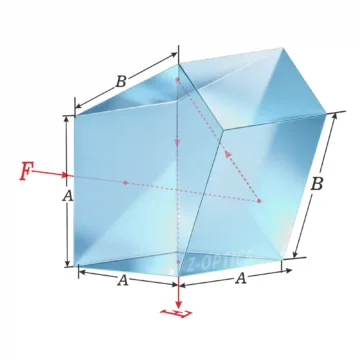
A Penta Prism is a five-sided reflective prism used to scatter a light beam by 90 °. The beam reflects twice inside the prism, allowing an image to be transmitted through a right angle without inverting it (i.e., without altering the handiness of the image) as an ordinary right-angle prism would. For optimum performance in the ultraviolet (UV), visible, or infrared (IR) spectrums, z-optics provides a selection of Penta Prisms. In addition, we provide half Penta prism. Without flipping or reversing the image, it is used to shift the line of sight by 45°. It is frequently used in telescopes and also has uses in geodesy, microscope tubes, projection and image systems, and Penta prism, half-Penta prism, and precision prism are all products. Please get in touch with us directly for pricing information or details on prisms that might work for your application.
-
-
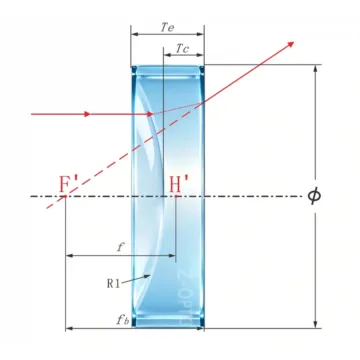
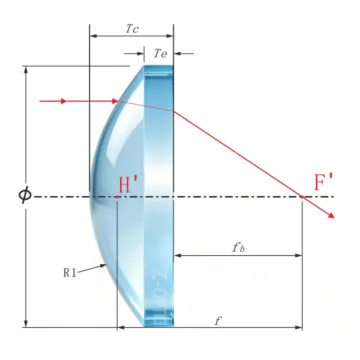
A plano-convex lens is a convergent lens having one convex and one flat surface. These lenses are intended for use in infinite conjugate (parallel light) applications or for basic imaging in non-critical applications. Plano-convex lenses are designed for infinite conjugate use or easy imaging in non-critical applications. They are positive focal length elements with a flat and spherical surface. A lens can be convex, concave, or flat depending on its surface.
-
-
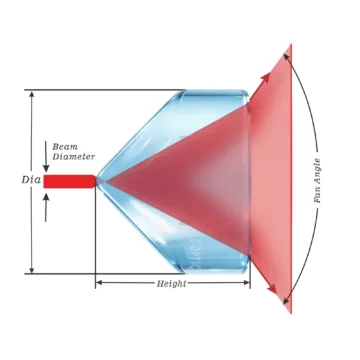
Powell Lenses narrow are specially engineered optical components that excel in transforming laser beams into a uniform, straight-line intensity distribution. These lenses are meticulously crafted to overcome the limitations of traditional beam-shaping technologies, offering a breakthrough in laser beam homogenization. They deliver an exceptionally uniform beam profile, eliminating hotspots and irregularities for enhanced laser performance and efficiency. With a focus on efficiency, Powell Lenses minimize energy loss, maximizing output power for cost-effective solutions.
-
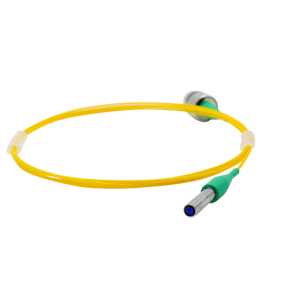
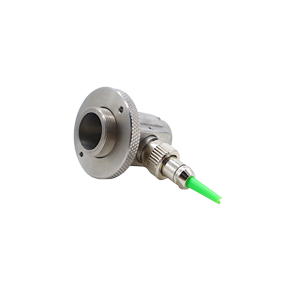
Reflective Achromatic Fiber Collimators uses a 90⁰ off-axis ellipsoidal mirror to couple free space laser beam into fiber or vice versa. Focal length of reflective mirror is irrelevant with wavelength. That makes it an idea solution to achromatic aberration. Al, Ag and Au is optional to be deposited as reflective film.
- Aluminum averages greater than 90% reflectance from 200nm to the far infrared, except in the 750 – 900nm region where it averages around 85% reflectance.
- Silver coatings can offer better performance in the visible and NIR from 450nm to 2μm.
- For IR performance gold coatings offer high reflectivity of around 97% from 700nm up to 10μm.
-
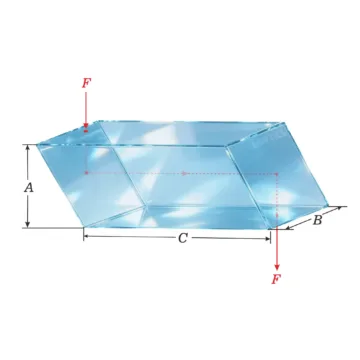
Our precision Rhomboid Prisms feature a parallelogram geometry designed to alter an optical path without changing beam direction. These high-quality optical prisms are engineered to displace a laser beam laterally while maintaining its original alignment. Ideal for precision imaging systems, they shift the optical axis without inverting or reverting the image. Tight angular tolerances guarantee that the output beam remains perfectly parallel to the input beam within 30 arcseconds. Key Features:
- High-precision lateral beam displacement.
- Parallel input/output alignment within 30 arcseconds.
- Shifts the optical axis without image inversion.
- Optimized for demanding beam steering and displacement applications.