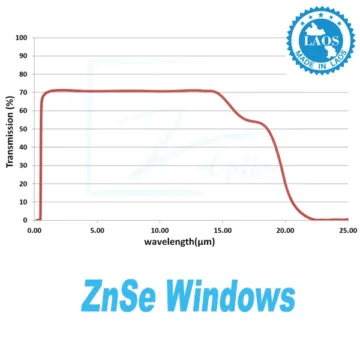
-
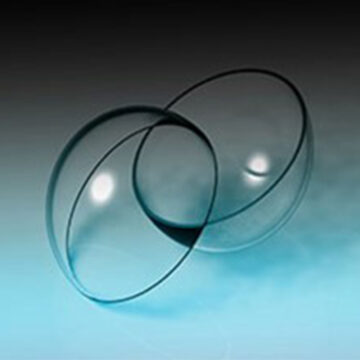
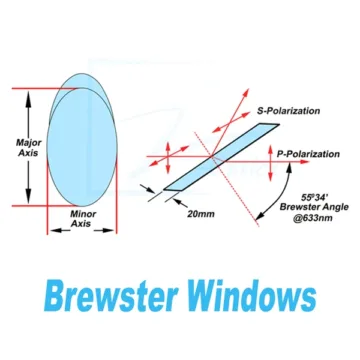
Brewster Windows are windows that are meant to be used at Brewster's angle (usually uncoated). This is the angle at which only incident p-polarized light has 0% transmission loss. Instead of exterior mirrors, a Brewster window is an uncoated substrate positioned at Brewster's angle within a laser. This substrate works as a polarizer, allowing p-polarized light to enter and exit the window without reflection losses while reflecting s-polarized light. Features
- Perfect for Laser Cavities.
- A substrate with UV Fused Silica.
- Without Reflection Losses, P-Polarized Light is Transmitted.
-
-
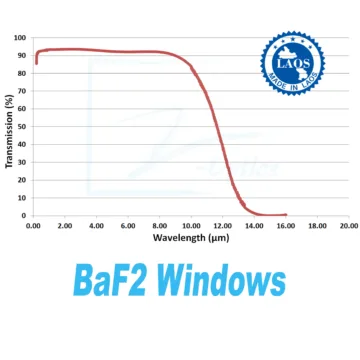
Barium Fluoride (BaF2) is the fastest known scintillator material; it has characteristics comparable to calcium fluoride but is more resistant to high-energy radiation. It is, however, more susceptible to water damage. Features
- High-Energy Radiation Resistant
- Transmission is excellent between 200nm - 12μm.
- Provide high transmission without the use of AR coatings.
-
Calcium Fluoride (CaF2) Windows have a high damage threshold and low absorption and are transparent from 180 nm to 8µm. It is a great choice for FTIR analysis, excimer laser systems, spectroscopic windows, and thermal imaging systems. Features:
- <1 arc-minute parallelism
- Ideally suited for excimer laser applications.
- Transparent in UV, visible, and infrared light.
- A low absorption rate and a high damage threshold
- In comparison to other IR materials, it has a low chromatic aberration.
-
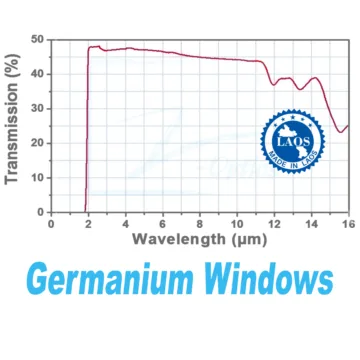
A Germanium Window is an optical window that is opaque to UV and visible light but transmits a wide range of infrared radiation. Because of its low dispersion, it exhibits little chromatic aberration. Germanium is also a material commonly for IR windows and lenses in thermal imaging systems. Features -
- Excellent for near-infrared and imaging applications.
- Anti-reflection coating with a wavelength range of 8 to 12 µm.
- This Window is ideal for low-power CO2 laser applications.
-
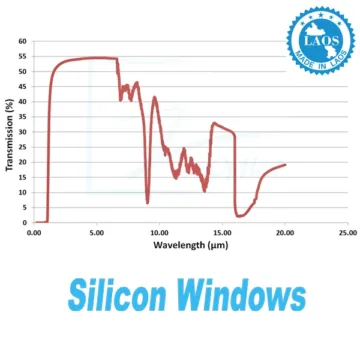
Silicon Windows are suitable for infrared applications due to their high transmittance between 1.2 and 7.0 μm. Silicon has a low density of 2.329 g/cm3, making it an excellent material for weight-sensitive applications. Features -
- Transmission range of 1.2 - 7μm.
- Available Uncoated or AR Coated for 3 - 5μm.
- Ideal for applications requiring low weight.
-
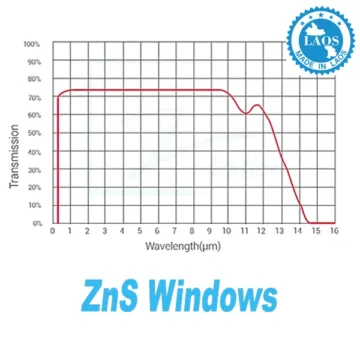
Zinc Sulphide (ZnS) windows have a high transmission range of 8-14 microns in the infrared (IR). It offers a wide transmission range for visible and mid-wave or long-wave infrared sensors, making it the ideal material for thermal imaging. Features
- Zinc Sulfide Substrate Multispectral Grade
- Low Absorption and Scatter from 0.4 to 12m
- Available uncoated or with an 8 to 12μm Broadband AR Coated Option
-
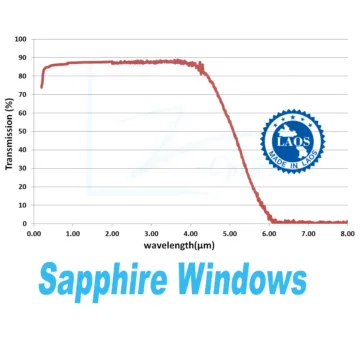
The mechanical properties of Sapphire include its great strength, thermal stability, wear resistance, and chemical inertness. As a result, a Sapphire Window outperforms other optical materials in severe conditions, acting as a shield between the elements. In optical and mechanical applications, sapphire windows are often used. Features
- Chemical resistance due to its high surface hardness.
- Transmits light at wavelengths ranging from ultraviolet to near-infrared.
- Thinner and stronger than standard glass windows.
- Available with anti-reflection coatings ranging from 400 to 5000nm
-
-
Fused Silica Windows are an excellent choice for high-precision, clear transmittance applications. They have low bulk scatter and autofluorescence, as well as incredibly high surface quality and parallelism. Many sectors use fused silica windows, including aircraft, astronomy, military and commercial avionics, medical and scientific instruments, academics and research, and industrial uses. They're an excellent choice for laser applications, spectroscopy, photolithography, vacuum windows, and a variety of other uses. Discover premium Fused Silica Windows from z optics . 0.1 angstrom roughness can be achieved with super polishing.
-
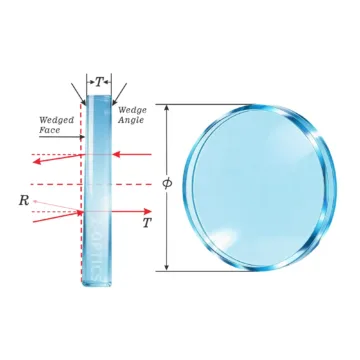
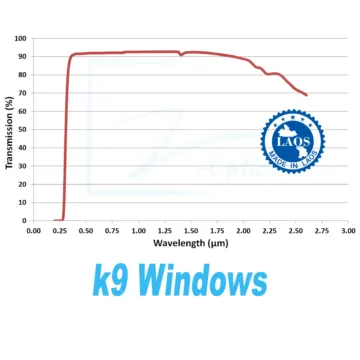
Z-Optics manufactures K9 glass windows featuring high-transmittance, plane-parallel glass designed to shield sensitive electronics and sensors without altering system magnification. Engineered for demanding medical, defense, and industrial applications, these precision windows deliver superior transmitted wavefront performance. We offer custom dimensions alongside specialized AR and scratch-resistant coatings to ensure peak durability and transmission for your specific optical setup.