Call Us Today! +856 20 5658 8665|sales@z-optics.com
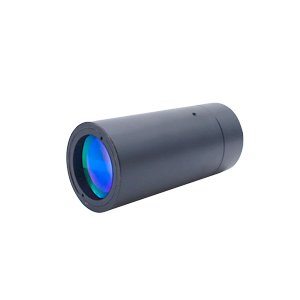
  • Ultra long work distance fiber collimators have over 2km work distance by expanding laser beam from fiber to dozens of millimeters, even over 100mm beam diameter. It's used in telemetry, illumination, lidar and so on, which project laser to remote distance. Multi-groups air-spaced lenses are used to optimize the power distribution. The beam spot is homogeneous and has clear board line.
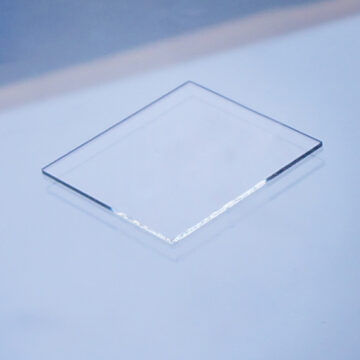
  • D263T eco is a clear borosilicate glass that has high chemical resistance. It is available in a variety of thicknesses ranging from 0.05 mm to 1.1 mm. Applications include use as cover glass, display glass, as coating or printed electronics substrate and as a replacement for plastic. In consumer electronics like LED chips, customers need ultra-low-cost windows in very big volumes. Normally Scott D263T is used as substrate. It's coated and diced to the desired size by blade or laser. Z-Optics deposits film on a big sheet of D263T and cut into the desired size upon requests of the customer by laser. Laser cutting possesses advantages of flexibility on shape, high precision and low cost.
    Introducing the Ultra Low Cost Windows from Z-optics, a pioneering optical component that redefines accessibility without compromising quality. Z-optics, a leader in optical innovation, has engineered these windows to provide an affordable yet high-performance solution for a wide range of applications. Designed with precision and efficiency in mind, the Ultra Low Cost Window by Z-optics offers a cost-effective alternative without sacrificing optical excellence. These windows are crafted with cutting-edge materials and manufacturing processes to ensure durability and longevity, making them an ideal choice for various industries seeking budget-friendly optical solutions. Z-optics' commitment to quality shines through in the Ultra Low Cost Window. Each component undergoes rigorous testing to meet the company's stringent standards. The result is an optical product that not only meets but exceeds expectations, delivering clarity and performance that rivals more expensive alternatives on the market. Versatility is a key feature of the Ultra Low Cost Window, making it suitable for diverse applications. From industrial settings to consumer electronics, these windows seamlessly integrate into different environments, providing cost-effective optical solutions for a broad spectrum of users. Z-optics understands the importance of accessibility in the modern world, and the Ultra Low Cost Windows reflect this ethos. By offering a product that combines affordability with cutting-edge technology, Z-optics aims to democratize access to high-quality optics, empowering businesses and individuals alike. In addition to their cost-effectiveness, these windows adhere to Z-optics' commitment to environmental responsibility. The manufacturing processes prioritize eco-friendly materials, reinforcing the company's dedication to sustainability. In conclusion, Z-optics' Low Cost Windows stand as a testament to the company's innovation and dedication to accessibility. By providing a high-quality optical component at an affordable price point, Z-optics continues to lead the way in making advanced optical technology accessible to a broader audience. Choose Ultra Low Cost Windows for unparalleled value without compromise in optical performance.
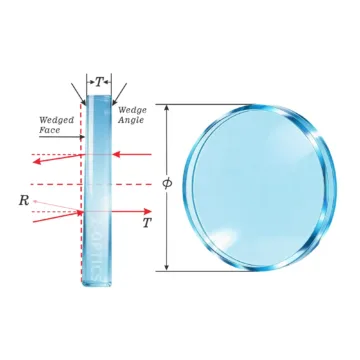
  • The high-precision Wedge Windows can avoid the etalon effect caused by the light reflected on the front and rear surfaces of the high-parallel Windows, and at the same time, it can also avoid interference with reflected beam, which causes power frustration and modes jumping.
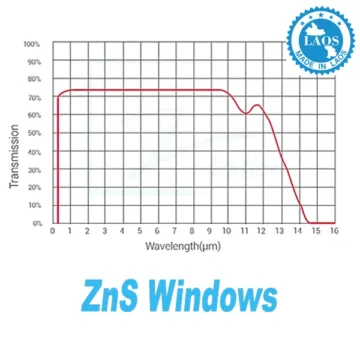
  • Zinc Sulphide (ZnS) windows have a high transmission range of 8-14 microns in the infrared (IR). It offers a wide transmission range for visible and mid-wave or long-wave infrared sensors, making it the ideal material for thermal imaging. Features
    • Zinc Sulfide Substrate Multispectral Grade
    • Low Absorption and Scatter from 0.4 to 12m
    • Available uncoated or with an 8 to 12μm Broadband AR Coated Option
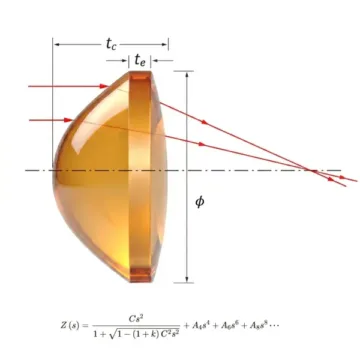
  • A Zinc Selenide (ZnSe) Aspheric Lens features a specialized surface profile designed to eliminate spherical aberration and minimize optical distortions like astigmatism, providing superior focus and clarity in infrared systems compared to standard spherical lenses. Main Applications of Our ZnSe Aspherical Lens:
    • CO2 Laser Collimation: Functions as a high-efficiency collimator or condenser for high-power infrared light sources.
    • Laser Beam Shaping: Serves as a precision collimator for high-power industrial and medical laser systems.
    • Fiber Optic Coupling: Acts as a high-performance coupling lens to efficiently focus infrared laser beams into optical fibers.
    • Infrared Thermal Imaging: Enhances resolution and image quality in thermal imaging cameras and FLIR systems operating in the MWIR and LWIR spectrums.
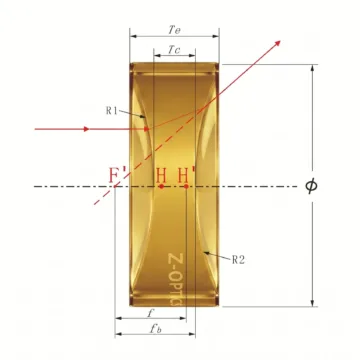
  • A Zinc Selenide (ZnSe) Double Concave Lens features two symmetrical inner-curved surfaces designed to diverge incident infrared light, increase focal lengths, and expand laser beams with exceptional wavefront clarity. Engineered from premium CVD laser-grade Zinc Selenide and optimized for a 10.6 µm design wavelength, these negative lenses come standard with our high-efficiency IR2 broadband anti-reflection (BBAR) coating, yielding an average reflectance (R_avg) of less than 1.5% across the 8–12 µm long-wave infrared (LWIR) spectrum.
    Main Applications of Our ZnSe Double Concave Lens:
    • CO2 Laser Beam Expansion: Functions as a highly durable negative component within Galilean beam expanders to safely diverge and enlarge high-power 10.6 µm laser beams before collimation.
    • Optical System Focal Extension: Serves as a precision diverging lens to counteract positive aberrations, minimize spherical distortion, and extend the effective focal length of multi-element IR imaging assemblies.
    • Infrared Imaging & Sensing: Acts as an efficient dispersing lens to widen the field of view for LWIR thermal imaging cameras, FLIR systems, and horizon-scanning optical sensors.
    • Industrial and Medical Laser Shaping: Optimizes beam profiles and energy distribution for precise material processing, micro-machining, and surgical laser systems.
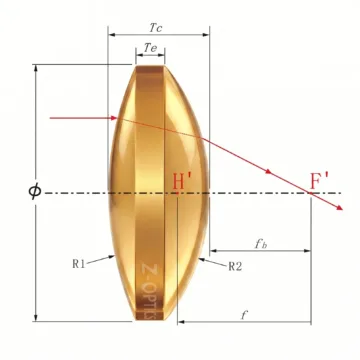
  • A Zinc Selenide (ZnSe) Double Convex Lens features two symmetrical, outward-curved surfaces engineered to converge incident infrared light, reduce focal lengths, and focus high-power laser beams with exceptional wavefront clarity. Fabricated from premium CVD laser-grade material and optimized for a 10.6 µm design wavelength, these bi-convex positive lenses deliver low bulk absorption and high transmission across the infrared spectrum.
    Applications of Our ZnSe Double Convex Lens:
    • CO2 Laser Focusing & Collimation: Functions as a highly efficient focusing element or beam collimator for high-power CO2 laser cutting, engraving, and welding systems.
    • Laser Beam Shaping: Serves as a precision focusing lens to concentrate infrared light into high-intensity spots for industrial and medical laser procedures.
    • Fiber Optic Coupling: Acts as a high-performance coupling lens to efficiently condense and couple infrared laser outputs directly into optical fibers.
    • Infrared Thermal Imaging: Works as a high-efficiency condenser lens to maximize light gathering and improve resolution in thermal imaging cameras and FLIR sensing systems operating in the MWIR and LWIR bands.
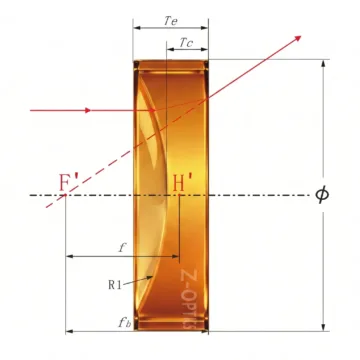
  • A Zinc Selenide (ZnSe) Plano-Concave Lens features one flat and one inward-curved surface engineered to diverge incident infrared light, extend focal lengths, and expand high-power laser beams with exceptional wavefront clarity. Fabricated from premium CVD laser-grade substrate material and optimized for a 10.6 µm design wavelength, these negative lenses deliver low bulk absorption and high transmission across the infrared spectrum. Available in both uncoated configurations and high-efficiency IR2 anti-reflection coatings (Ravg < 1.5% @ 8–12 µm), our lenses are precision-manufactured with a strict surface quality of 60-40 and an EFL tolerance of ±1%.
    Applications of Our ZnSe Plano-Concave Lens:
    • CO2 Laser Beam Expansion: Functions as a highly efficient diverging element in Galilean beam expander configurations for high-power 10.6 µm CO2 laser cutting, engraving, and marking systems.
    • Laser Beam Shaping & Aberration Correction: Serves as a precision diverging lens to balance spherical aberrations and optimize laser beam profiles in advanced industrial and medical optical paths.
    • Optical System Integration: Acts as a high-performance negative lens to extend focal lengths, control collimated beam diameters, and minimize power density on downstream optical components.
    • Infrared Thermal Imaging & FLIR: Works as a critical optical component to manipulate fields of view and balance optical paths in thermal imaging cameras and FLIR sensing systems operating across the 8–12 µm LWIR bands.
  • A Zinc Selenide (ZnSe) Aspheric Lens features a specialized surface profile designed to eliminate spherical aberration and minimize optical distortions like astigmatism, providing superior focus and clarity in infrared systems compared to standard spherical lenses. Main Applications of Our ZnSe Aspherical Lens:
    • CO2 Laser Collimation: Functions as a high-efficiency collimator or condenser for high-power infrared light sources.
    • Laser Beam Shaping: Serves as a precision collimator for high-power industrial and medical laser systems.
    • Fiber Optic Coupling: Acts as a high-performance coupling lens to efficiently focus infrared laser beams into optical fibers.
    • Infrared Thermal Imaging: Enhances resolution and image quality in thermal imaging cameras and FLIR systems operating in the MWIR and LWIR spectrums.
  • A Zinc Selenide (ZnSe) Aspheric Lens features a specialized surface profile designed to eliminate spherical aberration and minimize optical distortions like astigmatism, providing superior focus and clarity in infrared systems compared to standard spherical lenses. Main Applications of Our ZnSe Aspherical Lens:
    • CO2 Laser Collimation: Functions as a high-efficiency collimator or condenser for high-power infrared light sources.
    • Laser Beam Shaping: Serves as a precision collimator for high-power industrial and medical laser systems.
    • Fiber Optic Coupling: Acts as a high-performance coupling lens to efficiently focus infrared laser beams into optical fibers.
    • Infrared Thermal Imaging: Enhances resolution and image quality in thermal imaging cameras and FLIR systems operating in the MWIR and LWIR spectrums.
  • The ZnSe (Zinc Selenide) Wedge Beamsplitter is a optical component that has gained prominence in various scientific, industrial, and laser-based applications. This  is designed to split incident light into two separate beams, each with a specific ratio of reflected and transmitted light, making it an essential tool for precise light control in optical systems. The wedge-shaped design of this beamsplitter introduces a gradual change in thickness across its surface, allowing for precise control of the splitting ratio. This feature is particularly advantageous in interferometry and laser applications where controlling the phase and power of optical beams is crucial. The ZnSe Wedge Beamsplitter's accuracy and consistency empower researchers and engineers to achieve the level of precision required for their experiments and projects.
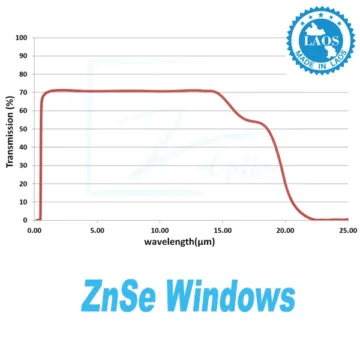
  • ZnSe (Zinc Selenide) windows are specialized optical plates that look like yellow, transparent glass. Unlike regular glass windows that block infrared (IR) light, ZnSe is specifically designed to let heat and laser energy pass through it with almost no resistance.
    Because of their unique ability to handle infrared light, ZnSe windows are essential in several high-priority industries:
    • Industrial Laser Cutting: Acts as a protective shield for high-power CO2 lasers, preventing debris from damaging optics without losing beam power.
    • Thermal Imaging & Night Vision: Serves as the primary entry lens for thermal cameras (FLIR), allowing heat signatures to be detected in total darkness.
    • Medical Equipment: Integrated into surgical laser systems where precision and thermal stability are critical for patient safety.
    • Scientific Research: A core component in IR spectroscopy, enabling the identification of chemical compositions through light analysis.
Go to Top