-
Z-Optics provides a full line of laser diodes from 405nm to 1625nm. All the products are qualified and operate reliably. Most products are on the shelf for quick delivery. Products listed in the table are not always updated on time. So just please tell us the wavelength, power, and package if not listed here, we will check our stock for you.
-
Z-Optics provides visible and infrared laser modules with circular, elliptic, linear, and cross-hair beam profiles in a variety of packages and configurations at very competitive prices. Our engineers have optics, crystal and laser background, years experiences in laser module design and production, which make us competitive in integrating the optics, electrics and laser together according to the requirements of customers. We promise one week delivery time for samples and 1-2 weeks for mass order.

 Our Capability: Super Linearity and Flatness - A line laser module is developed, with only <2mm height difference over 1x1m2 flat surface, visible or infrared wavelength.Super Small Laser Module - A 650nm laser module is developed, with only 3.3mm diameter.Super directivity - the beam spot lies on the centre line of the laser module by fine design and adjustment.A 532nm laser module is under developing, which has the widest operation temperature window, -10~+50 Celsius degree. The most power-saving 532nm laser module is under developing
*More dimensions, package, power level and high-quality products please download our catalogue
Our Capability: Super Linearity and Flatness - A line laser module is developed, with only <2mm height difference over 1x1m2 flat surface, visible or infrared wavelength.Super Small Laser Module - A 650nm laser module is developed, with only 3.3mm diameter.Super directivity - the beam spot lies on the centre line of the laser module by fine design and adjustment.A 532nm laser module is under developing, which has the widest operation temperature window, -10~+50 Celsius degree. The most power-saving 532nm laser module is under developing
*More dimensions, package, power level and high-quality products please download our catalogue
-
Z-Optics provides visible and infrared laser modules with circular, elliptic, linear, and cross-hair beam profiles in a variety of packages and configurations at very competitive prices. Our engineers have optics, crystal and laser background, years experience in laser module design and production, which make us competitive in integrating the optics, electrics and laser together according to the requirements of customers. We promise one week delivery time for samples and 1-2 weeks for mass order.
Our Capability: Super Linearity and Flatness - A line laser module is developed, with only <2mm height difference over 1x1m2 flat surface, visible or infrared wavelength.Super Small Laser Module - A 650nm laser module is developed, with only 3.3mm diameter.Super directivity - the beam spot lies on the centre line of the laser module by fine design and adjustment.A 532nm laser module is under developing, which has the widest operation temperature window, -10~+50 Celsius degree. The most power-saving 532nm laser module is under developing
*More dimensions, package, power level and high-quality products please download our catalogue
-
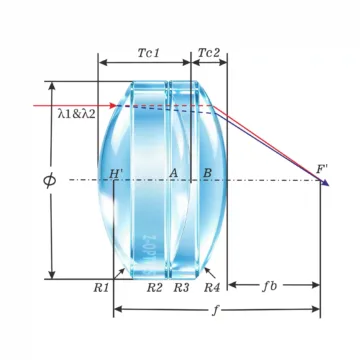
An achromatic lens is a type of lens that is designed to reduce chromatic aberration, which is the tendency of a lens to produce different colors of light in focus at different points. This is accomplished by combining two or more glass elements with different refractive indices. The most common type of achromatic lens is the doublet, which is made up of two elements, one concave and one convex. Achromatic lenses are commonly used in photography, telescope, microscope, and other imaging systems. They are also used in eyeglasses, binoculars and other optical instruments.
-
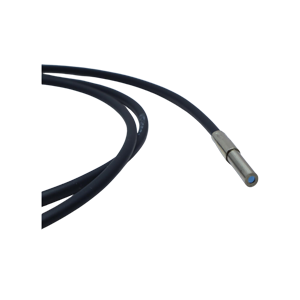
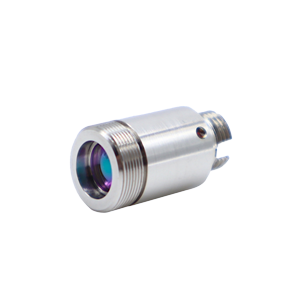
Normally there exits offset or angle between Optical axis and mechanic axis of fiber collimator. That causes great insert loss. Collimators can’t be plug and play or rotated in use. The offset and angle between optical axis and mechanic axis of aligned fiber collimator are eliminated with ingenious design and precise assembling. It greatly improves installation efficiency with free adjustment. It also supports rotation of fiber collimator in use and can be used in optical fiber rotary connectors and other products.
-
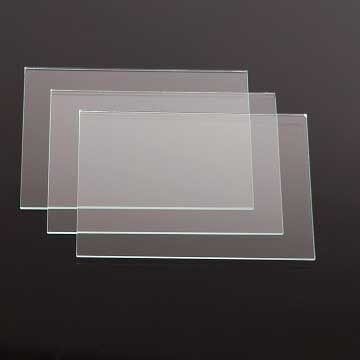
AG glass Windows is used on-screen to reduce sunlight/light reflection. The surface is etched by chemical to specified gloss, roughness and haze. A finished window might need post-treatment such as silk-screen printing, 3M double sides adhesive, heat tempered, coating. Please contact us for more information, supports or free samples.
-
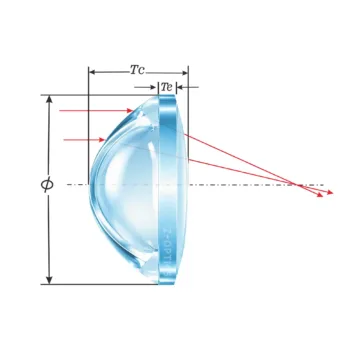
An Aspheric Lens is one whose surface profiles do not resemble those of a sphere or cylinder. In comparison to a basic lens, Aspherical Lens can reduce or eliminate spherical aberration and also other optical distortions such as astigmatism. Main Applications of Our Aspherical Lens: - Collimator or condenser of the light source. - Collimator of laser. - Coupling lens to focus laser into an optical fiber. - Imaging
-
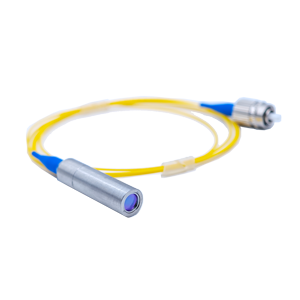
Aspheric Lens Fiberport Collimators can correct spherical aberration. Energy of the laser has a Gaussian distribution and beam is well collimated. But it can‘t correct chromatic aberration. Because focal length of aspherical lens is related to wavelength.
-
-
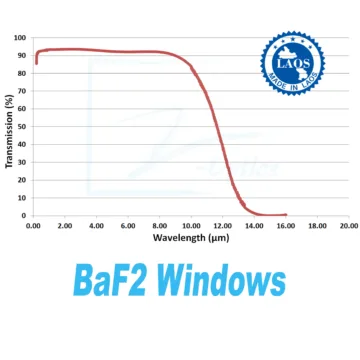
Barium Fluoride (BaF2) is the fastest known scintillator material; it has characteristics comparable to calcium fluoride but is more resistant to high-energy radiation. It is, however, more susceptible to water damage. Features
- High-Energy Radiation Resistant
- Transmission is excellent between 200nm - 12μm.
- Provide high transmission without the use of AR coatings.
-
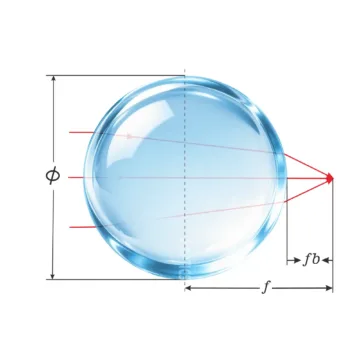
A special type of thick biconvex optical lens is a Ball lenses that usually has a sphere geometric shape. These are made of a single material such as BK7 or other optical glass/Fused Silica/CaF2 which is a commonly used material for ball lenses. The smallest lens we produced is < 0.5 mm. We can process ball lenses using all types of glass material. Our price for PV industry may be as low as USD0.02/pcs. We are developing CSD-based AR-coating to provide a low-cost PV-coating solution.
-
At Z-Optics, we engineer hard-coated BANDPASS FILTER - FWHM 1~2nm optics for high-precision Raman spectroscopy, fluorescence, and laser selection. Featuring center wavelengths from 375nm to 1064nm, these narrow bandpass filters deliver peak transmission up to 90%, deep out-of-band rejection (OD4 across 200-1200nm), and standard diameters of 12.7mm and 25.4mm. Designed to meet strict industrial standards, they maximize the signal-to-noise ratio in advanced instrumentation.