- CO2 Laser Collimation: Functions as a high-efficiency collimator or condenser for high-power infrared light sources.
- Laser Beam Shaping: Serves as a precision collimator for high-power industrial and medical laser systems.
- Fiber Optic Coupling: Acts as a high-performance coupling lens to efficiently focus infrared laser beams into optical fibers.
- Infrared Thermal Imaging: Enhances resolution and image quality in thermal imaging cameras and FLIR systems operating in the MWIR and LWIR spectrums.
-
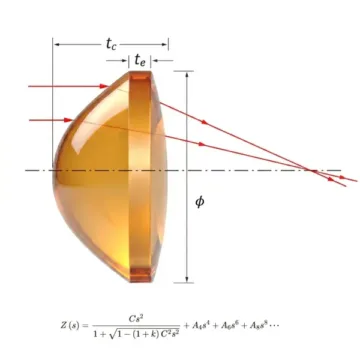
A Zinc Selenide (ZnSe) Aspheric Lens features a specialized surface profile designed to eliminate spherical aberration and minimize optical distortions like astigmatism, providing superior focus and clarity in infrared systems compared to standard spherical lenses. Main Applications of Our ZnSe Aspherical Lens:
-
A Zinc Selenide (ZnSe) Aspheric Lens features a specialized surface profile designed to eliminate spherical aberration and minimize optical distortions like astigmatism, providing superior focus and clarity in infrared systems compared to standard spherical lenses. Main Applications of Our ZnSe Aspherical Lens:
- CO2 Laser Collimation: Functions as a high-efficiency collimator or condenser for high-power infrared light sources.
- Laser Beam Shaping: Serves as a precision collimator for high-power industrial and medical laser systems.
- Fiber Optic Coupling: Acts as a high-performance coupling lens to efficiently focus infrared laser beams into optical fibers.
- Infrared Thermal Imaging: Enhances resolution and image quality in thermal imaging cameras and FLIR systems operating in the MWIR and LWIR spectrums.
-
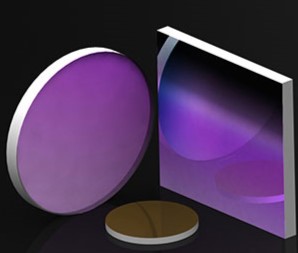
Broadband Dielectric Coated Flat Mirror, a optical component by Z-optics Company. This s mirror exemplifies Z-optics' unwavering commitment to precision engineering, innovation, and delivering superior optical solutions. This mirror is its high-quality dielectric coating. This dielectric coating not only ensures broad-spectrum reflectivity but also imparts exceptional durability, making the Broadband Dielectric Coated Flat Mirror a reliable choice for a myriad of optical applications. The mirror's flat substrate, constructed with meticulous attention to detail, serves as a stable base for the dielectric coating, guaranteeing consistent optical performance. Z-optics' stringent quality control measures are applied throughout the manufacturing process, ensuring that each mirror meets the company's exacting standards for precision and reliability.
-
At Z-Optics, we offer high-performance bandpass filters with a Full Width at Half Maximum (FWHM) greater than 60 nm, expertly engineered to provide broad spectral selection for applications where wider bandwidths are essential. These filters deliver reliable wavelength isolation with high transmission efficiency, making them ideal for everyday industrial, scientific, and imaging applications that require consistent performance in demanding environments.
-
At Z-Optics, we offer premium-quality bandpass filters with a Full Width at Half Maximum (FWHM) of 50 to 60 nm, engineered to provide excellent spectral selection in a wider bandwidth range. These filters deliver reliable wavelength isolation with high transmission and effective out-of-band blocking, making them ideal for applications where broader spectral control is essential.
-
At Z-Optics, we design premium bandpass filters with FWHM 5~6 nm tailored for applications requiring a balance of spectral selectivity and high throughput, including advanced imaging, fluorescence, and laser systems. Our filters deliver excellent wavelength isolation, high peak transmission, and robust out-of-band blocking to enhance signal fidelity and system sensitivity.
-
At Z-Optics, our bandpass filters with FWHM 40~50 nm deliver reliable wavelength selection tailored for applications requiring moderate spectral resolution. These filters offer broad bandwidth suitable for fluorescence imaging, LED-based illumination systems, optical communication, and general light filtering applications — ensuring high transmission and efficient out-of-band rejection for enhanced optical system performance.
-
At Z-Optics, our bandpass filters with FWHM 20–35 nm deliver reliable spectral filtering solutions for applications requiring moderate bandwidth and superior optical performance. Designed for enhanced light transmission and effective out-of-band blocking, these filters are ideal for fluorescence imaging, biomedical diagnostics, laser line isolation, and multispectral sensing technologies.
-
At Z-Optics, we design precision bandpass filters with a Full Width Half Maximum (FWHM) of 2~3 nm, engineered for applications requiring outstanding spectral selectivity such as LiDAR systems, fluorescence spectroscopy, astronomical observation, and advanced sensor technologies. Our bandpass filters deliver ultra-narrow bandwidths that effectively minimize noise and spectral overlap, enhancing signal clarity even in challenging environments like light-polluted astronomical settings or complex laser setups.
-
At Z-Optics, our bandpass filters with a Full Width at Half Maximum (FWHM) of 10 to 15 nm are engineered for versatile optical systems requiring moderate spectral selectivity. These filters strike the perfect balance between spectral bandwidth and transmission efficiency, making them ideal for a wide range of scientific, industrial, and medical applications. With excellent out-of-band blocking and stable center wavelength control, they ensure consistent performance and reliable signal isolation.
-
At Z-Optics, we engineer hard-coated BANDPASS FILTER - FWHM 1~2nm optics for high-precision Raman spectroscopy, fluorescence, and laser selection. Featuring center wavelengths from 375nm to 1064nm, these narrow bandpass filters deliver peak transmission up to 90%, deep out-of-band rejection (OD4 across 200-1200nm), and standard diameters of 12.7mm and 25.4mm. Designed to meet strict industrial standards, they maximize the signal-to-noise ratio in advanced instrumentation.
-