-
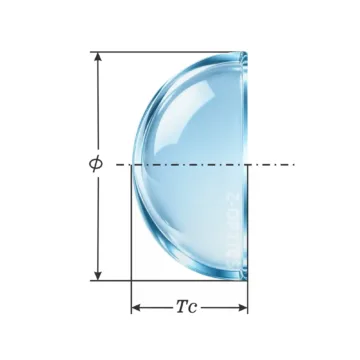
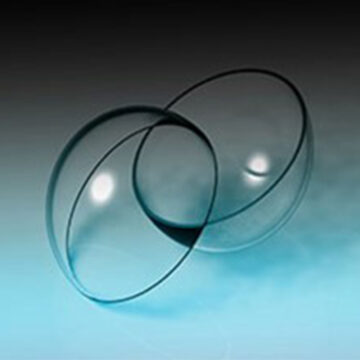
The hemispheres of the Half-ball lens have uniform light dispersion and are commonly used in high power LED and UV LED, focusing and coupling light. It has many advantages over silicone lens and plastic lens. Our half-ball lenses are made from BK7, B270, Fused Silica, Sapphire, and more. We can also deliver custom Half-Ball lenses and alternative materials in a range of diameters.
-
Why you should choose Z-Optics
-
-
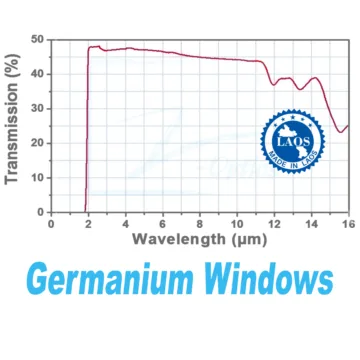
A Germanium Window is an optical window that is opaque to UV and visible light but transmits a wide range of infrared radiation. Because of its low dispersion, it exhibits little chromatic aberration. Germanium is also a material commonly for IR windows and lenses in thermal imaging systems. Features -
- Excellent for near-infrared and imaging applications.
- Anti-reflection coating with a wavelength range of 8 to 12 µm.
- This Window is ideal for low-power CO2 laser applications.
-
Fused Silica Windows are an excellent choice for high-precision, clear transmittance applications. They have low bulk scatter and autofluorescence, as well as incredibly high surface quality and parallelism. Many sectors use fused silica windows, including aircraft, astronomy, military and commercial avionics, medical and scientific instruments, academics and research, and industrial uses. They're an excellent choice for laser applications, spectroscopy, photolithography, vacuum windows, and a variety of other uses. Discover premium Fused Silica Windows from z optics . 0.1 angstrom roughness can be achieved with super polishing.
-
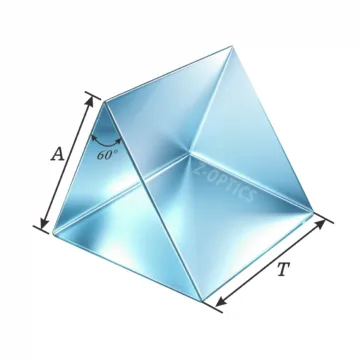
Our high-precision Equilateral Prisms (also known as dispersing prisms) feature three equal 60° angles, making them ideal for high-performance wavelength separation and beam refraction applications. Engineered for tight optical setups, these prisms deliver minimal distortion and excellent light dispersion across the visible spectrum.
-
-
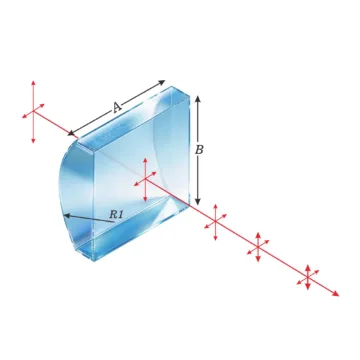
- Z-OPTICS has big catalog of cylindrical lens off-the-shelf for quick delivery and provides quick sampling service for new drawings.
- Multiplicity of materials, Glass, Fused Silica, Sapphire, CaF2, ZnSe ….
- Innovative low cost plano convex cylindrical lens is available.
Overview
- Ready Stock: Z-Optics offers a large catalog of cylindrical lenses available for fast delivery and custom sampling for your unique designs.
- Material Multiplicity: Select from premium optical glass, fused silica, sapphire, CaF2, ZnSe, and more—a solution for every requirement.
- Cost-Effective Options: Innovative low-cost plano convex cylindrical lenses and specialized shapes for demanding optical applications.
-
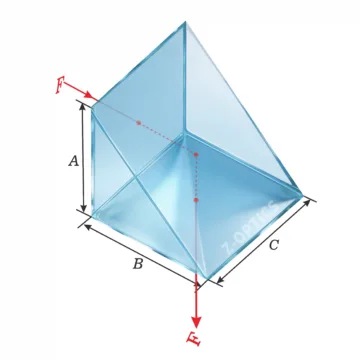
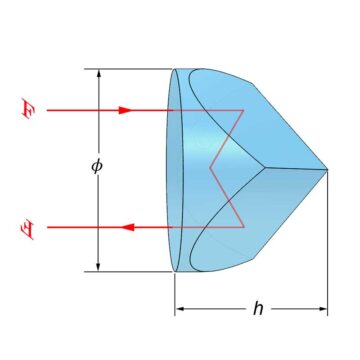
Z-optics is a leading manufacturer of Corner Cube Retroreflectors for a wide range of applications. We are proud to be a biggest manufacturer of Corner Cube Retroreflectors worldwide, producing nearly half a million pieces each year. Our dedication to providing high-quality retroreflectors ensures that our customers receive the precision and reliability they need for their specific applications.

-
Calcium Fluoride (CaF2) Windows have a high damage threshold and low absorption and are transparent from 180 nm to 8µm. It is a great choice for FTIR analysis, excimer laser systems, spectroscopic windows, and thermal imaging systems. Features:
- <1 arc-minute parallelism
- Ideally suited for excimer laser applications.
- Transparent in UV, visible, and infrared light.
- A low absorption rate and a high damage threshold
- In comparison to other IR materials, it has a low chromatic aberration.
-
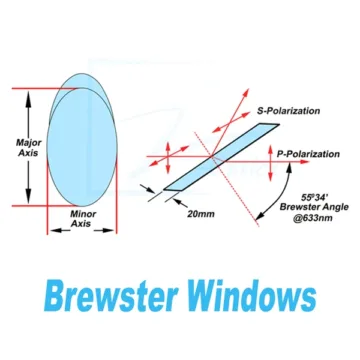
Brewster Windows are windows that are meant to be used at Brewster's angle (usually uncoated). This is the angle at which only incident p-polarized light has 0% transmission loss. Instead of exterior mirrors, a Brewster window is an uncoated substrate positioned at Brewster's angle within a laser. This substrate works as a polarizer, allowing p-polarized light to enter and exit the window without reflection losses while reflecting s-polarized light. Features
- Perfect for Laser Cavities.
- A substrate with UV Fused Silica.
- Without Reflection Losses, P-Polarized Light is Transmitted.
-
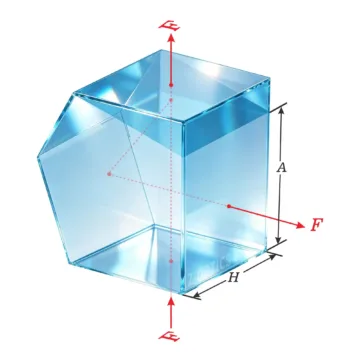
Beamsplitter Penta Prism is produced by bringing together a precision Penta Prism and a wedge prism and adding an appropriate interference coating to one of the typically reflective surfaces. Since minor motions of a Penta Prism do not influence the true right angle at which light rays are reflected, the difference between the light rays transmitted and reflected is highly controllable